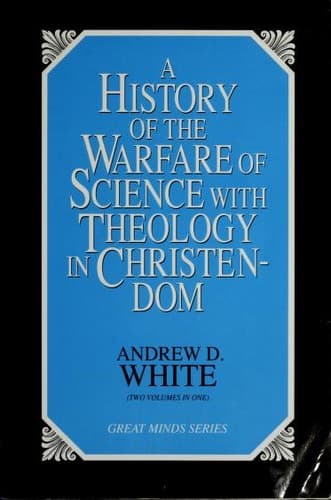
History of the Warfare of Science with Theology in ChristendomWhite, Andrew Dickson
Religion
History of the Warfare of Science with Theology in Christendom
White, Andrew Dickson
Religion and science -- History
And Kepler comes: he leads science on to greater victories. Copernicus,
great as he was, could not disentangle scientific reasoning entirely
from the theological bias: the doctrines of Aristotle and Thomas Aquinas
as to the necessary superiority of the circle had vitiated the minor
features of his system, and left breaches in it through which the enemy
was not slow to enter; but Kepler sees these errors, and by wonderful
genius and vigour he gives to the world the three laws which bear his
name, and this fortress of science is complete. He thinks and speaks
as one inspired. His battle is severe. He is solemnly warned by the
Protestant Consistory of Stuttgart "not to throw Christ's kingdom into
confusion with his silly fancies," and as solemnly ordered to "bring
his theory of the world into harmony with Scripture": he is sometimes
abused, sometimes ridiculed, sometimes imprisoned. Protestants in Styria
and Wurtemberg, Catholics in Austria and Bohemia, press upon him but
Newton, Halley, Bradley, and other great astronomers follow, and to
science remains the victory.(73)
(73) For Campanella, see Amabile, Fra Tommaso Campanella, Naples, 1882,
especially vol. iii; also Libri, vol. iv, pp. 149 et seq. Fromundus,
speaking of Kepler's explanation, says, "Vix teneo ebullientem risum."
This is almost equal to the New York Church Journal, speaking of John
Stuart Mill as "that small sciolist," and of the preface to Dr. Draper's
great work as "chippering." How a journal, generally so fair in its
treatment of such subjects, can condescend to such weapons is one of the
wonders of modern journalism. For the persecution of Kepler, see Heller,
Geschichte der Physik, vol. i, pp. 281 et seq; also Reuschle, Kepler und
die Astronomie, Frankfurt a. M., 1871, pp. 87 et seq. There is a poetic
justice in the fact that these two last-named books come from Wurtemberg
professors. See also The New-Englander for March, 1884, p. 178.
Yet this did not end the war. During the seventeenth century, in France,
after all the splendid proofs added by Kepler, no one dared openly teach
the Copernican theory, and Cassini, the great astronomer, never declared
for it. In 1672 the Jesuit Father Riccioli declared that there
were precisely forty-nine arguments for the Copernican theory and
seventy-seven against it. Even after the beginning of the eighteenth
century--long after the demonstrations of Sir Isaac Newton--Bossuet,
the great Bishop of Meaux, the foremost theologian that France has ever
produced, declared it contrary to Scripture.
Public-domain text, read in full here on John Shaqi.
Reviews
Reviews
No reviews yet
Be the first to share your thoughts on this work.
Elsewhere in the archive
Join the Discussion
Join the discussion
Sign in to leave a comment or review.
Sign InorCreate an account