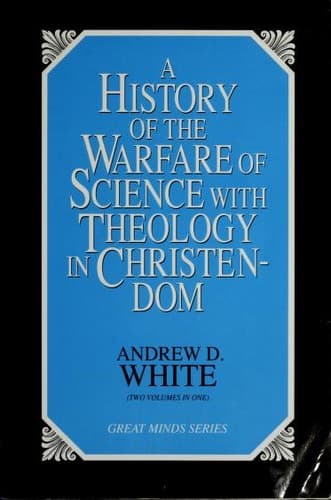
History of the Warfare of Science with Theology in ChristendomWhite, Andrew Dickson
Religion
History of the Warfare of Science with Theology in Christendom
White, Andrew Dickson
Religion and science -- History
In 1757 the most enlightened perhaps in the whole line of the popes,
Benedict XIV, took up the matter, and the Congregation of the Index
secretly allowed the ideas of Copernicus to be tolerated. Yet in 1765
Lalande, the great French astronomer, tried in vain at Rome to induce
the authorities to remove Galileo's works from the Index. Even at a
date far within our own nineteenth century the authorities of many
universities in Catholic Europe, and especially those in Spain, excluded
the Newtonian system. In 1771 the greatest of them all, the University
of Salamanca, being urged to teach physical science, refused, making
answer as follows: "Newton teaches nothing that would make a good
logician or metaphysician; and Gassendi and Descartes do not agree so
well with revealed truth as Aristotle does."
Vengeance upon the dead also has continued far into our own century. On
the 5th of May, 1829, a great multitude assembled at Warsaw to honour
the memory of Copernicus and to unveil Thorwaldsen's statue of him.
Copernicus had lived a pious, Christian life; he had been beloved for
unostentatious Christian charity; with his religious belief no fault had
ever been found; he was a canon of the Church at Frauenberg, and over
his grave had been written the most touching of Christian epitaphs.
Naturally, then, the people expected a religious service; all was
understood to be arranged for it; the procession marched to the church
and waited. The hour passed, and no priest appeared; none could be
induced to appear. Copernicus, gentle, charitable, pious, one of the
noblest gifts of God to religion as well as to science, was evidently
still under the ban. Five years after that, his book was still standing
on the Index of books prohibited to Christians.
Public-domain text, read in full here on John Shaqi.
Reviews
Reviews
No reviews yet
Be the first to share your thoughts on this work.
Elsewhere in the archive
Join the Discussion
Join the discussion
Sign in to leave a comment or review.
Sign InorCreate an account