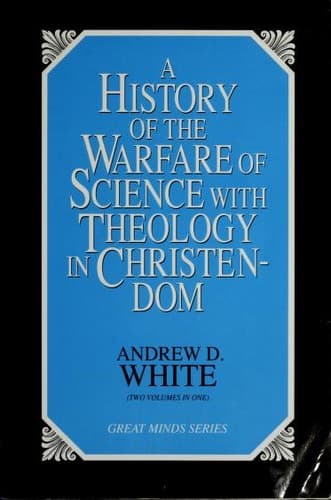
History of the Warfare of Science with Theology in ChristendomWhite, Andrew Dickson
Religion
History of the Warfare of Science with Theology in Christendom
White, Andrew Dickson
Religion and science -- History
(91) For Hindu theories, see Alabaster, Wheel of the Law, 11. For Greek
and Roman legends, See Higgins, Anacalypsis, vol. i, pp. 616, 617.; also
Suetonius, Caes., Julius, p. 88, Claud., p. 46; Seneca, Quaest. Nat.,
vol. i, p. 1, vol. vii, p. 17; Pliny, Hist. Nat., vol. ii, p. 25;
Tacitus, Ann., vol. xiv, p. 22; Josephus, Antiq., vol. xiv, p. 12; and
the authorities above cited. For the tradition of the Jews regarding
the darkness of three days, see citation in Renan, Histoire du Peuple
Israel, vol. iv, chap. iv. For Tertullian's belief regarding the
significance of an eclipse, see the Ad Scapulum, chap. iii, in Migne,
Patrolog. Lat., vol. i, p. 701. For the claim regarding Charles I, see
a sermon preached before Charles II, cited by Lecky, England in the
Eighteenth Century, vol. i, p. 65. Mather thought, too, that it might
have something to do with the death of sundry civil functionaries of
the colonies; see his Discourse concerning comets, 1682. For Archbishop
Sandy's belief, see his eighteenth sermon (in Parker Soc. Publications).
The story of Abraham Davenport has been made familiar by the poem of
Whittier.
In these beliefs regarding meteors and eclipses there was little
calculated to do harm by arousing that superstitious terror which is
the worst breeding-bed of cruelty. Far otherwise was it with the belief
regarding comets. During many centuries it gave rise to the direst
superstition and fanaticism. The Chaldeans alone among the ancient
peoples generally regarded comets without fear, and thought them bodies
wandering as harmless as fishes in the sea; the Pythagoreans alone among
philosophers seem to have had a vague idea of them as bodies returning
at fixed periods of time; and in all antiquity, so far as is known, one
man alone, Seneca, had the scientific instinct and prophetic inspiration
to give this idea definite shape, and to declare that the time would
come when comets would be found to move in accordance with natural law.
Here and there a few strong men rose above the prevailing superstition.
The Emperor Vespasian tried to laugh it down, and insisted that a
certain comet in his time could not betoken his death, because it was
hairy, and he bald; but such scoffing produced little permanent effect,
and the prophecy of Seneca was soon forgotten. These and similar
isolated utterances could not stand against the mass of opinion which
upheld the doctrine that comets are "signs and wonders."(92)
(92) For terror caused in Rome by comets, see Pingre, Cometographie, pp.
165, 166. For the Chaldeans, see Wolf, Geschichte der Astronomie, p. 10
et seq., and p. 181 et seq.; also Pingre, chap. ii. For the Pythagorean
notions, see citations from Plutarch in Costard, History of Astronomy,
p. 283. For Seneca's prediction, see Guillemin, World of Comets
(translated by Glaisher), pp. 4, 5; also Watson, On Comets, p. 126. For
this feeling in antiquity generally, see the preliminary chapters of the
two works last cited.
Public-domain text, read in full here on John Shaqi.
Reviews
Reviews
No reviews yet
Be the first to share your thoughts on this work.
Elsewhere in the archive
Join the Discussion
Join the discussion
Sign in to leave a comment or review.
Sign InorCreate an account