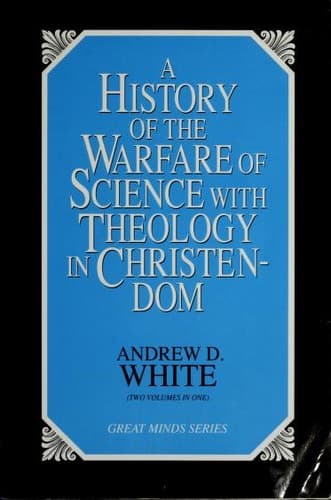
History of the Warfare of Science with Theology in ChristendomWhite, Andrew Dickson
Religion
History of the Warfare of Science with Theology in Christendom
White, Andrew Dickson
Religion and science -- History
The belief that every comet is a ball of fire flung from the right hand
of an angry God to warn the grovelling dwellers of earth was received
into the early Church, transmitted through the Middle Ages to the
Reformation period, and in its transmission was made all the more
precious by supposed textual proofs from Scripture. The great fathers of
the Church committed themselves unreservedly to it. In the third century
Origen, perhaps the most influential of the earlier fathers of the
universal Church in all questions between science and faith, insisted
that comets indicate catastrophes and the downfall of empires and
worlds. Bede, so justly revered by the English Church, declared in the
eighth century that "comets portend revolutions of kingdoms, pestilence,
war, winds, or heat"; and John of Damascus, his eminent contemporary
in the Eastern Church, took the same view. Rabanus Maurus, the great
teacher of Europe in the ninth century, an authority throughout the
Middle Ages, adopted Bede's opinion fully. St. Thomas Aquinas, the great
light of the universal Church in the thirteenth century, whose works the
Pope now reigning commends as the centre and source of all university
instruction, accepted and handed down the same opinion. The sainted
Albert the Great, the most noted genius of the medieval Church in
natural science, received and developed this theory. These men and
those who followed them founded upon scriptural texts and theological
reasonings a system that for seventeen centuries defied every advance of
thought.(93)
(93) For Origen, se his De Princip., vol. i, p. 7; also Maury, Leg.
pieuses, p. 203, note. For Bede and others, see De Nat., vol. xxiv; Joh.
Dam., De Fid. Or.,vol. ii, p. 7; Maury, La Magie et l'Astronomie, pp.
181, 182. For Albertus Magnus, see his Opera, vol. i, tr. iii, chaps.
x, xi. Among the texts of Scripture on which this belief rested was
especially Joel ii, 30, 31.
The main evils thence arising were three: the paralysis of self-help,
the arousing of fanaticism, and the strengthening of ecclesiastical
and political tyranny. The first two of these evils--the paralysis of
self-help and the arousing of fanaticism--are evident throughout
all these ages. At the appearance of a comet we constantly see all
Christendom, from pope to peasant, instead of striving to avert war
by wise statesmanship, instead of striving to avert pestilence by
observation and reason, instead of striving to avert famine by skilful
economy, whining before fetiches, trying to bribe them to remove these
signs of God's wrath, and planning to wreak this supposed wrath of God
upon misbelievers.
Public-domain text, read in full here on John Shaqi.
Reviews
Reviews
No reviews yet
Be the first to share your thoughts on this work.
Elsewhere in the archive
Join the Discussion
Join the discussion
Sign in to leave a comment or review.
Sign InorCreate an account