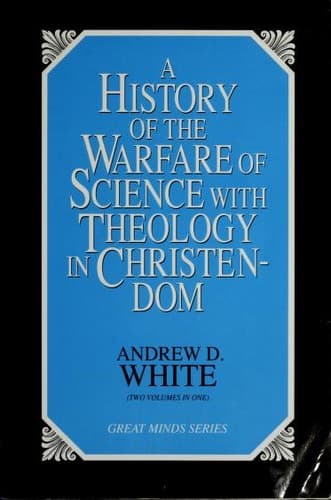
History of the Warfare of Science with Theology in ChristendomWhite, Andrew Dickson
Religion
History of the Warfare of Science with Theology in Christendom
White, Andrew Dickson
Religion and science -- History
The first of these is the case of Michael Maestlin. He was by birth a
Swabian Protestant, was educated at Tubingen as a pupil of Apian, and,
after a period of travel, was settled as deacon in the little parish
of Backnang, when the comet of 1577 gave him an occasion to apply his
astronomical studies. His minute and accurate observation of it is to
this day one of the wonders of science. It seems almost impossible that
so much could be accomplished by the naked eye. His observations agreed
with those of Tycho Brahe, and won for Maestlin the professorship of
astronomy in the University of Heidelberg. No man had so clearly proved
the supralunar position of a comet, or shown so conclusively that
its motion was not erratic, but regular. The young astronomer, though
Apian's pupil, was an avowed Copernican and the destined master and
friend of Kepler. Yet, in the treatise embodying his observations, he
felt it necessary to save his reputation for orthodoxy by calling
the comet a "new and horrible prodigy," and by giving a chapter of
"conjectures on the signification of the present comet," in which he
proves from history that this variety of comet betokens peace, but
peace purchased by a bloody victory. That he really believed in this
theological theory seems impossible; the very fact that his observations
had settled the supralunar character and regular motion of comets proves
this. It was a humiliation only to be compared to that of Osiander
when he wrote his grovelling preface to the great book of Copernicus.
Maestlin had his reward: when, a few years, later his old teacher,
Apian, was driven from his chair at Tubingen for refusing to sign the
Lutheran Concord-Book, Maestlin was elected to his place.
Not less striking was the effect of this theological pressure upon the
minds of students. Noteworthy as an example of this is the book of the
Leipsic lawyer, Buttner. From no less than eighty-six biblical texts
he proves the Almighty's purpose of using the heavenly bodies for the
instruction of men as to future events, and then proceeds to frame
exhaustive tables, from which, the time and place of the comet's first
appearance being known, its signification can be deduced. This manual
he gave forth as a triumph of religious science, under the name of the
Comet Hour-Book.(104)
(104) For Maestlin, see his Observatio et Demonstration Cometae,
Tubingen, 1578. For Buttner, see his Cometen Stundbuchlein, Leipsic,
1605.
Public-domain text, read in full here on John Shaqi.
Reviews
Reviews
No reviews yet
Be the first to share your thoughts on this work.
Elsewhere in the archive
Join the Discussion
Join the discussion
Sign in to leave a comment or review.
Sign InorCreate an account