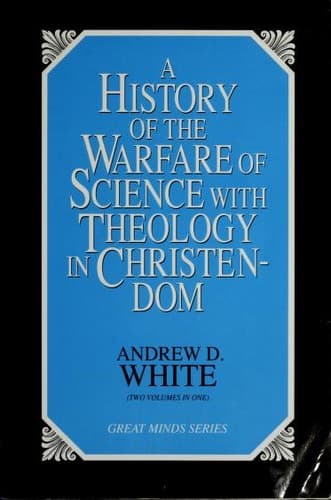
History of the Warfare of Science with Theology in ChristendomWhite, Andrew Dickson
Religion
History of the Warfare of Science with Theology in Christendom
White, Andrew Dickson
Religion and science -- History
The same devotion to the portent theory is found in the universities
of Protestant Holland. Striking is it to see in the sixteenth century,
after Tycho Brahe's discovery, the Dutch theologian, Gerard Vossius,
Professor of Theology and Eloquence at Leyden, lending his great weight
to the superstition. "The history of all times," he says, "shows comets
to be the messengers of misfortune. It does not follow that they are
endowed with intelligence, but that there is a deity who makes use of
them to call the human race to repentance." Though familiar with the
works of Tycho Brahe, he finds it "hard to believe" that all comets are
ethereal, and adduces several historical examples of sublunary ones.
Nor was this attempt to hold back university teaching to the old view of
comets confined to Protestants. The Roman Church was, if possible,
more strenuous in the same effort. A few examples will serve as types,
representing the orthodox teaching at the great centres of Catholic
theology.
One of these is seen in Spain. The eminent jurist Torreblanca was
recognised as a controlling authority in all the universities of Spain,
and from these he swayed in the seventeenth century the thought of
Catholic Europe, especially as to witchcraft and the occult powers
in Nature. He lays down the old cometary superstition as one of the
foundations of orthodox teaching: Begging the question, after the
fashion of his time, he argues that comets can not be stars, because new
stars always betoken good, while comets betoken evil.
The same teaching was given in the Catholic universities of the
Netherlands. Fromundus, at Louvain, the enemy of Galileo, steadily
continued his crusade against all cometary heresy.(105)
(105) For Vossius, see the De Idololatria (in his Opera, vol. v, pp.
283-285). For Torreblanc, see his De Magia, Seville, 1618, and often
reprinted. For Fromundus, see his Meteorologica.
But a still more striking case is seen in Italy. The reverend Father
Augustin de Angelis, rector of the Clementine College at Rome, as late
as 1673, after the new cometary theory had been placed beyond reasonable
doubt, and even while Newton was working out its final demonstration,
published a third edition of his Lectures on Meteorology. It was
dedicated to the Cardinal of Hesse, and bore the express sanction of
the Master of the Sacred Palace at Rome and of the head of the religious
order to which De Angelis belonged. This work deserves careful analysis,
not only as representing the highest and most approved university
teaching of the time at the centre of Roman Catholic Christendom, but
still more because it represents that attempt to make a compromise
between theology and science, or rather the attempt to confiscate
science to the uses of theology, which we so constantly find whenever
the triumph of science in any field has become inevitable.
Public-domain text, read in full here on John Shaqi.
Reviews
Reviews
No reviews yet
Be the first to share your thoughts on this work.
Elsewhere in the archive
Join the Discussion
Join the discussion
Sign in to leave a comment or review.
Sign InorCreate an account