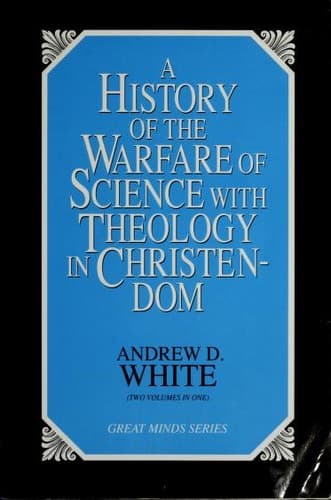
History of the Warfare of Science with Theology in ChristendomWhite, Andrew Dickson
Religion
History of the Warfare of Science with Theology in Christendom
White, Andrew Dickson
Religion and science -- History
observed by him in 1618 brought not only war, famine, pestilence, and
earthquake, but also a general volcanic eruption, "which would have
destroyed Naples, had not the blood of the invincible martyr Januarius
withstood it."
(106) Barbata et caudata.
It will be observed, even from this sketch, that, while the learned
Father Augustin thus comes infallibly to the mediaeval conclusion, he
does so very largely by scientific and essentially modern processes,
giving unwonted prominence to observation, and at times twisting
scientific observation into the strand with his metaphysics. The
observations and methods of his science are sometimes shrewd, sometimes
comical. Good examples of the latter sort are such as his observing that
the comet stood very near the summit of Vesuvius, and his reasoning
that its tail was kept in place by its stickiness. But observations and
reasonings of this sort are always the first homage paid by theology to
science as the end of their struggle approaches.(107)
(107) See De Angelis, Lectiones Meteorologicae, Rome, 1669.
Equally striking is an example seen a little later in another part of
Europe; and it is the more noteworthy because Halley and Newton had
already fully established the modern scientific theory. Just at the
close of the seventeenth century the Jesuit Reinzer, professor at Linz,
put forth his Meteorologia Philosophico-Politica, in which all natural
phenomena received both a physical and a moral interpretation. It was
profusely and elaborately illustrated, and on account of its instructive
contents was in 1712 translated into German for the unlearned reader.
The comet receives, of course, great attention. "It appears," says
Reinzer, "only then in the heavens when the latter punish the earth, and
through it (the comet) not only predict but bring to pass all sorts of
calamity.... And, to that end, its tail serves for a rod, its hair for
weapons and arrows, its light for a threat, and its heat for a sign of
anger and vengeance." Its warnings are threefold: (1) "Comets, generated
in the air, betoken NATURALLY drought, wind, earthquake, famine, and
pestilence." (2) "Comets can indirectly, in view of their material,
betoken wars, tumults, and the death of princes; for, being hot and
dry, they bring the moistnesses (Feuchtigkeiten) in the human body to
an extraordinary heat and dryness, increasing the gall; and, since the
emotions depend on the temperament and condition of the body, men are
through this change driven to violent deeds, quarrels, disputes, and
finally to arms: especially is this the result with princes, who
are more delicate and also more arrogant than other men, and whose
moistnesses are more liable to inflammation of this sort, inasmuch as
they live in luxury and seldom restrain themselves from those things
which in such a dry state of the heavens are especially injurious." (3)
"All comets, whatever prophetic significance they may have naturally
Public-domain text, read in full here on John Shaqi.
Reviews
Reviews
No reviews yet
Be the first to share your thoughts on this work.
Elsewhere in the archive
Join the Discussion
Join the discussion
Sign in to leave a comment or review.
Sign InorCreate an account