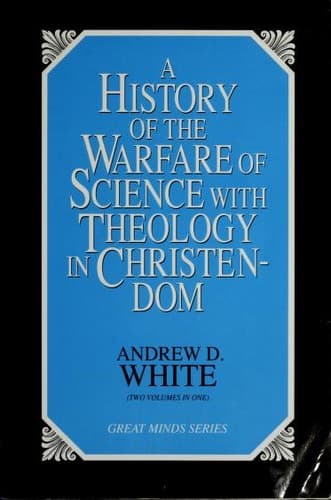
History of the Warfare of Science with Theology in ChristendomWhite, Andrew Dickson
Religion
History of the Warfare of Science with Theology in Christendom
White, Andrew Dickson
Religion and science -- History
in and of themselves, are yet principally, according to the Divine
pleasure, heralds of the death of great princes, of war, and of other
such great calamities; and this is known and proved, first of all, from
the words of Christ himself: 'Nation shall rise against nation, and
kingdom against kingdom; and great earthquakes shall be in divers
places, and famines, and pestilences; and fearful sights and great signs
shall there be from heaven.'"(108)
(108) See Reinzer, Meteorologica Philosophico-Politica (edition of
Augsburg, 1712), pp. 101-103.
While such pains was taken to keep the more highly educated classes
in the "paths of scriptural science and sound learning;" at the
universities, equal efforts were made to preserve the cometary orthodoxy
of the people at large by means of the pulpits. Out of the mass of
sermons for this purpose which were widely circulated I will select just
two as typical, and they are worthy of careful study as showing some
special dangers of applying theological methods to scientific facts.
In the second half of the sixteenth century the recognised capital of
orthodox Lutheranism was Magdeburg, and in the region tributary to this
metropolis no Church official held a more prominent station than the
"Superintendent," or Lutheran bishop, of the neighbouring Altmark. It
was this dignitary, Andreas Celichius by name, who at Magdeburg, in
1578, gave to the press his Theological Reminder of the New Comet.
After deprecating as blasphemous the attempt of Aristotle to explain the
phenomenon otherwise than as a supernatural warning from God to sinful
man, he assures his hearers that "whoever would know the comet's real
source and nature must not merely gape and stare at the scientific
theory that it is an earthy, greasy, tough, and sticky vapour and mist,
rising into the upper air and set ablaze by the celestial heat." Far
more important for them is it to know what this vapour is. It is really,
in the opinion of Celichius, nothing more or less than "the thick smoke
of human sins, rising every day, every hour, every moment, full of
stench and horror, before the face of God, and becoming gradually so
thick as to form a comet, with curled and plaited tresses, which at last
is kindled by the hot and fiery anger of the Supreme Heavenly Judge."
He adds that it is probably only through the prayers and tears of
Christ that this blazing monument of human depravity becomes visible to
mortals. In support of this theory, he urges the "coming up before God"
of the wickedness of Sodom and Gomorrah and of Nineveh, and especially
the words of the prophet regarding Babylon, "Her stench and rottenness
is come up before me." That the anger of God can produce the
conflagration without any intervention of Nature is proved from the
Psalms, "He sendeth out his word and melteth them." From the position
of the comet, its course, and the direction of its tail he augurs
especially the near approach of the judgment day, though it may also
Public-domain text, read in full here on John Shaqi.
Reviews
Reviews
No reviews yet
Be the first to share your thoughts on this work.
Elsewhere in the archive
Join the Discussion
Join the discussion
Sign in to leave a comment or review.
Sign InorCreate an account