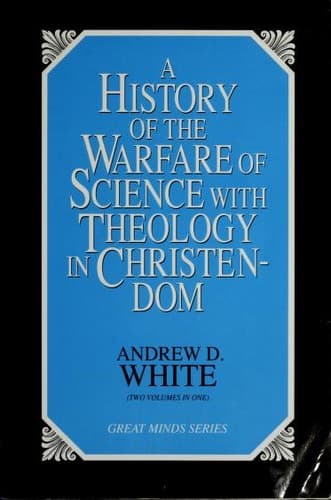
History of the Warfare of Science with Theology in ChristendomWhite, Andrew Dickson
Religion
History of the Warfare of Science with Theology in Christendom
White, Andrew Dickson
Religion and science -- History
from the Bible and from Luther, he winds up by insisting that, as God
can make nothing in vain, comets must have some distinct object; then,
from Isaiah and Joel among the prophets, from Matthew, Mark, and
Luke among the evangelists, from Origen and John Chrysostom among the
fathers, from Luther and Melanchthon among the Reformers, he draws
various texts more or less conclusive to prove that comets indicate evil
and only evil; and he cites Luther's Advent sermon to the effect that,
though comets may arise in the course of Nature, they are still signs
of evil to mankind. In answer to the theory of sundry naturalists that
comets are made up of "a certain fiery, warm, sulphurous, saltpetery,
sticky fog," he declaims: "Our sins, our sins: they are the fiery heated
vapours, the thick, sticky, sulphurous clouds which rise from the
earth toward heaven before God." Throughout the sermon Dieterich pours
contempt over all men who simply investigate comets as natural objects,
calls special attention to a comet then in the heavens resembling a long
broom or bundle of rods, and declares that he and his hearers can only
consider it rightly "when we see standing before us our Lord God in
heaven as an angry father with a rod for his children." In answer to the
question what comets signify, he commits himself entirely to the idea
that they indicate the wrath of God, and therefore calamities of every
sort. Page after page is filled with the records of evils following
comets. Beginning with the creation of the world, he insists that
the first comet brought on the deluge of Noah, and cites a mass of
authorities, ranging from Moses and Isaiah to Albert the Great and
Melanchthon, in support of the view that comets precede earthquakes,
famines, wars, pestilences, and every form of evil. He makes some parade
of astronomical knowledge as to the greatness of the sun and moon, but
relapses soon into his old line of argument. Imploring his audience not
to be led away from the well-established belief of Christendom and the
principles of their fathers, he comes back to his old assertion, insists
that "our sins are the inflammable material of which comets are made,"
and winds up with a most earnest appeal to the Almighty to spare his
people.(110)
(110) For Deiterich, see Ulmische Cometen-Predigt, von dem Cometen, so
nechst abgewischen 1618 Jahrs im Wintermonat erstenmahls in Schwaben
sehen lassen,... gehalten zu Ulm... durch Conrad Dieterich, Ulm, 1620.
For a life of the author, see article Dieterich in the Allgemeine
Deutsche Biographie. See also Wolf.
Public-domain text, read in full here on John Shaqi.
Reviews
Reviews
No reviews yet
Be the first to share your thoughts on this work.
Elsewhere in the archive
Join the Discussion
Join the discussion
Sign in to leave a comment or review.
Sign InorCreate an account