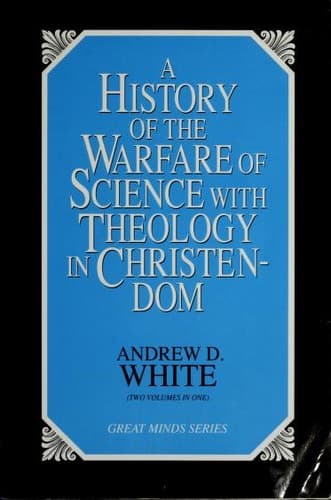
History of the Warfare of Science with Theology in ChristendomWhite, Andrew Dickson
Religion
History of the Warfare of Science with Theology in Christendom
White, Andrew Dickson
Religion and science -- History
betoken, as usual, famine, pestilence, and war. "Yet even in these
days," he mourns, "there are people reckless and giddy enough to pay
no heed to such celestial warnings, and these even cite in their own
defence the injunction of Jeremiah not to fear signs in the heavens."
This idea he explodes, and shows that good and orthodox Christians,
while not superstitious like the heathen, know well "that God is not
bound to his creation and the ordinary course of Nature, but must often,
especially in these last dregs of the world, resort to irregular means
to display his anger at human guilt."(109)
(109) For Celichius, or Celich, see his own treatise, as above.
The other typical case occurred in the following century and in another
part of Germany. Conrad Dieterich was, during the first half of the
seventeenth century, a Lutheran ecclesiastic of the highest authority.
His ability as a theologian had made him Archdeacon of Marburg,
Professor of Philosophy and Director of Studies at the University of
Giessen, and "Superintendent," or Lutheran bishop, in southwestern
Germany. In the year 1620, on the second Sunday in Advent, in the great
Cathedral of Ulm, he developed the orthodox doctrine of comets in a
sermon, taking up the questions: 1. What are comets? 2. What do they
indicate? 3. What have we to do with their significance? This sermon
marks an epoch. Delivered in that stronghold of German Protestantism
and by a prelate of the highest standing, it was immediately printed,
prefaced by three laudatory poems from different men of note, and sent
forth to drive back the scientific, or, as it was called, the "godless,"
view of comets. The preface shows that Dieterich was sincerely alarmed
by the tendency to regard comets as natural appearances. His text was
taken from the twenty-fifth verse of the twenty-first chapter of St.
Luke: "And there shall be signs in the sun, and in the moon, and in the
stars; and upon the earth distress of nations, with perplexity; the sea
and the waves roaring." As to what comets are, he cites a multitude of
philosophers, and, finding that they differ among themselves, he uses a
form of argument not uncommon from that day to this, declaring that this
difference of opinion proves that there is no solution of the problem
save in revelation, and insisting that comets are "signs especially sent
by the Almighty to warn the earth." An additional proof of this he
finds in the forms of comets. One, he says, took the form of a trumpet;
another, of a spear; another of a goat; another, of a torch; another, of
a sword; another, of an arrow; another, of a sabre; still another, of a
bare arm. From these forms of comets he infers that we may divine their
purpose. As to their creation, he quotes John of Damascus and other
early Church authorities in behalf of the idea that each comet is a
star newly created at the Divine command, out of nothing, and that it
indicates the wrath of God. As to their purpose, having quoted largely
Public-domain text, read in full here on John Shaqi.
Reviews
Reviews
No reviews yet
Be the first to share your thoughts on this work.
Elsewhere in the archive
Join the Discussion
Join the discussion
Sign in to leave a comment or review.
Sign InorCreate an account