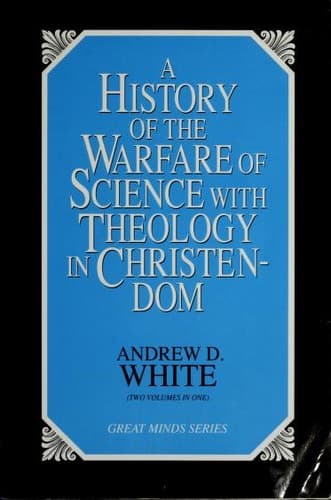
History of the Warfare of Science with Theology in ChristendomWhite, Andrew Dickson
Religion
History of the Warfare of Science with Theology in Christendom
White, Andrew Dickson
Religion and science -- History
I. ORIGIN AND PROGRESS OF HOSTILITY TO LOANS AT INTEREST.
Universal belief in the sin of loaning money at interest
The taking of interest among the Greeks and Romans
Opposition of leaders of thought, especially Aristotle
Condemnation of the practice by the Old and New Testaments
By the Church fathers
In ecclesiastical and secular legislation
Exception sometimes made in behalf of the Jews
Hostility of the pulpit
Of the canon law
Evil results of the prohibition of loans at interest
Efforts to induce the Church to change her position
Theological evasions of the rule
Attitude of the Reformers toward the taking of interest
Struggle in England for recognition of the right to accept
interest
Invention of a distinction between usury and interest
II. RETREAT OF THE CHURCH, PROTESTANT AND CATHOLIC.
Sir Robert Filmer's attack on the old doctrine
Retreat of the Protestant Church in Holland
In Germany and America
Difficulties in the way of compromise in the Catholic Church
Failure of such attempts in France
Theoretical condemnation of usury in Italy
Disregard of all restrictions in practice
Attempts of Escobar and Liguori to reconcile the taking of
interest with the teachings of the Church
Montesquieu's attack on the old theory
Encyclical of Benedict XIV permitting the taking of interest
Similar decision of the Inquisition at Rome
Final retreat of the Catholic Church
Curious dealings of theology with public economy in other fields
CHAPTER XX.
FROM THE DIVINE ORACLES TO THE HIGHER CRITICISM.
I. THE OLDER INTERPRETATION.
Character of the great sacred
books of the world
General laws governing the development and influence of sacred
literature.--The law of its origin
Legends concerning the Septuagint
The law of wills and causes
The law of inerrancy
Hostility to the revision of King James's translation of the
Bible
The law of unity
Working of these laws seen in the great rabbinical schools
The law of allegorical interpretation
Philo
Judaeus
Justin Martyr and Clement of Alexandria
Occult significance of numbers
Origen
Hilary of Poitiers and Jerome
Augustine
Gregory the Great
Vain attempts to check the flood of allegorical interpretations
Bede.--Savonarola
Methods of modern criticism for the first time employed by
Lorenzo Valla
Erasmus
Influence of the Reformation on the belief in the infallibility
of the sacred books.--Luther and Melanchthon
Development of scholasticism in the Reformed Church
Catholic belief in the inspiration of the Vulgate
Opposition in Russia to the revision of the Slavonic Scriptures
Sir Isaac Newton as a commentator
Scriptural interpretation at the beginning of the eighteenth
century
Public-domain text, read in full here on John Shaqi.
Reviews
Reviews
No reviews yet
Be the first to share your thoughts on this work.
Join the Discussion
Join the discussion
Sign in to leave a comment or review.
Sign InorCreate an account