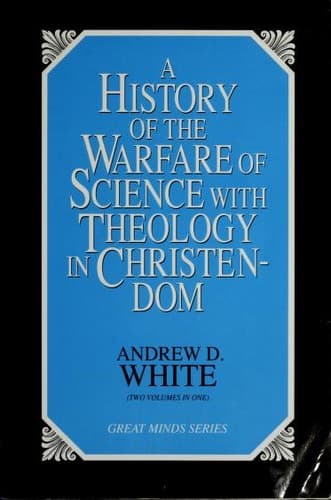
History of the Warfare of Science with Theology in ChristendomWhite, Andrew Dickson
Religion
History of the Warfare of Science with Theology in Christendom
White, Andrew Dickson
Religion and science -- History
But in 1680 a stronger than either of these seized upon the doctrine
and wielded it with power. Increase Mather, so open always to ideas
from Europe, and always so powerful for good or evil in the cloonies,
preached his sermon on "Heaven's Alarm to the World,... wherein is shown
that fearful sights and signs in the heavens are the presages of great
calamities at hand." The texts were taken from the book of Revelation:
"And the third angel sounded, and there fell a great star from heaven,
burning, as it were a lamp," and "Behold, the third woe cometh quickly."
In this, as in various other sermons, he supports the theological
cometary theory fully. He insists that "we are fallen into the dregs
of time," and that the day of judgment is evidently approaching. He
explains away the words of Jeremiah--"Be not dismayed at signs in the
heavens"--and shows that comets have been forerunners of nearly every
form of evil. Having done full justice to evils thus presaged in
scriptural times, he begins a similar display in modern history by
citing blazing stars which foretold the invasions of Goths, Huns,
Saracens, and Turks, and warns gainsayers by citing the example of
Vespasian, who, after ridiculing a comet, soon died. The general shape
and appearance of comets, he thinks, betoken their purpose, and he cites
Tertullian to prove them "God's sharp razors on mankind, whereby he doth
poll, and his scythe whereby he doth shear down multitudes of sinful
creatures." At last, rising to a fearful height, he declares: "For the
Lord hath fired his beacon in the heavens among the stars of God there;
the fearful sight is not yet out of sight. The warning piece of heaven
is going off. Now, then, if the Lord discharge his murdering pieces from
on high, and men be found in their sins unfit for death, their blood
shall be upon them." And again, in an agony of supplication, he cries
out: "Do we see the sword blazing over us? Let it put us upon crying
to God, that the judgment be diverted and not return upon us again so
speedily.... Doth God threaten our very heavens? O pray unto him, that he
would not take away stars and send comets to succeed them."(112)
(112) For Danforth, see his Astronomical Descritption of the Late Comet
or Blazing Star, Together with a Brief Theological Application Thereof,
1664. For Morton, see his Memorial, pp. 251, 252,; also 309, 310. Texts
cited by Mather were Rev., viii, 10, and xi, 14.
Public-domain text, read in full here on John Shaqi.
Reviews
Reviews
No reviews yet
Be the first to share your thoughts on this work.
Elsewhere in the archive
Join the Discussion
Join the discussion
Sign in to leave a comment or review.
Sign InorCreate an account