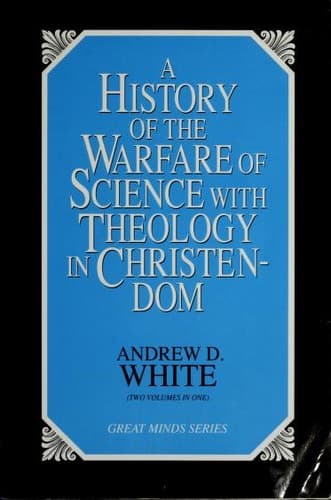
History of the Warfare of Science with Theology in ChristendomWhite, Andrew Dickson
Religion
History of the Warfare of Science with Theology in Christendom
White, Andrew Dickson
Religion and science -- History
Two years later, in August, 1682, he followed this with another sermon
on "The Latter Sign," "wherein is showed that the voice of God in
signal providences, especially when repeated and iterated, ought to be
hearkened unto." Here, too, of course, the comet comes in for a large
share of attention. But his tone is less sure: even in the midst of all
his arguments appears an evident misgiving. The thoughts of Newton in
science and Bayle in philosophy were evidently tending to accomplish
the prophecy of Seneca. Mather's alarm at this is clear. His natural
tendency is to uphold the idea that a comet is simply a fire-ball flung
from the hand of an avenging God at a guilty world, but he evidently
feels obliged to yield something to the scientific spirit; hence, in the
Discourse concerning Comets, published in 1683, he declares: "There are
those who think that, inasmuch as comets may be supposed to proceed from
natural causes, there is no speaking voice of Heaven in them beyond what
is to be said of all other works of God. But certain it is that many
things which may happen according to the course of Nature are portentous
signs of Divine anger and prognostics of great evils hastening upon the
world." He then notices the eclipse of August, 1672, and adds: "That
year the college was eclipsed by the death of the learned president
there, worthy Mr. Chauncey and two colonies--namely, Massachusetts and
Plymouth--by the death of two governors, who died within a twelvemonth
after.... Shall, then, such mighty works of God as comets are be
insignificant things?"(113)
(113) Increase Mather's Heaven's Alarm to the World was first printed
at Boston in 1681, but was reprinted in 1682, and was appended, with the
sermon on The Latter Sign, to the Discourse on Comets (Boston, 1683).
III. THE INVASION OF SCEPTICISM.
Vigorous as Mather's argument is, we see scepticism regarding "signs"
continuing to invade the public mind; and, in spite of his threatenings,
about twenty years after we find a remarkable evidence of this progress
in the fact that this scepticism has seized upon no less a personage
than that colossus of orthodoxy, his thrice illustrious son, Cotton
Mather himself; and him we find, in 1726, despite the arguments of his
father, declaring in his Manuductio: "Perhaps there may be some need for
me to caution you against being dismayed at the signs of the heavens,
or having any superstitious fancies upon eclipses and the like.... I am
willing that you be apprehensive of nothing portentous in blazing stars.
For my part, I know not whether all our worlds, and even the sun itself,
may not fare the better for them."(114)
(114) For Cotton Mather, see the Manuductio, pp. 54, 55.
Public-domain text, read in full here on John Shaqi.
Reviews
Reviews
No reviews yet
Be the first to share your thoughts on this work.
Elsewhere in the archive
Join the Discussion
Join the discussion
Sign in to leave a comment or review.
Sign InorCreate an account