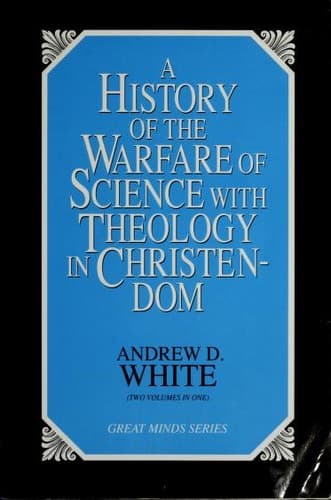
History of the Warfare of Science with Theology in ChristendomWhite, Andrew Dickson
Religion
History of the Warfare of Science with Theology in Christendom
White, Andrew Dickson
Religion and science -- History
In the seventeenth century able arguments against the superstition, on
general grounds, began to be multiplied. In Holland, Balthasar Bekker
opposed this, as he opposed the witchcraft delusion, on general
philosophic grounds; and Lubienitzky wrote in a compromising spirit to
prove that comets were as often followed by good as by evil events. In
France, Pierre Petit, formerly geographer of Louis XIII, and an intimate
friend of Descartes, addressed to the young Louis XIV a vehement protest
against the superstition, basing his arguments not on astronomy, but on
common sense. A very effective part of the little treatise was devoted
to answering the authority of the fathers of the early Church. To do
this, he simply reminded his readers that St. Augustine and St. John
Damascenus had also opposed the doctrine of the antipodes. The book
did good service in France, and was translated in Germany a few years
later.(116)
(116) For Blaise de Vigenere, see his Traite des Cometes, Paris, 1578.
For Dudith, see his De Cometarum Dignificatione, Basle, 1579, to which
the letter of Erastus is appended. Bekker's views may be found in
his Onderzoek van de Betekening der Cometen, Leeuwarden, 1683. For
Lubienitsky's, see his Theatrum Cometicum, Amsterdam, 1667, in part
ii: Historia Cometarum, preface "to the reader." For Petit, see his
Dissertation sur la Nature des Cometes, Paris, 1665 (German translation,
Dresden and Zittau, 1681).
All these were denounced as infidels and heretics, yet none the less did
they set men at thinking, and prepare the way for a far greater genius;
for toward the end of the same century the philosophic attack was taken
up by Pierre Bayle, and in the whole series of philosophic champions he
is chief. While professor at the University of Sedan he had observed the
alarm caused by the comet of 1680, and he now brought all his reasoning
powers to bear upon it. Thoughts deep and witty he poured out in volume
after volume. Catholics and Protestants were alike scandalized. Catholic
France spurned him, and Jurieu, the great Reformed divine, called his
cometary views "atheism," and tried hard to have Protestant Holland
condemn him. Though Bayle did not touch immediately the mass of mankind,
he wrought with power upon men who gave themselves the trouble of
thinking. It was indeed unfortunate for the Church that theologians,
instead of taking the initiative in this matter, left it to Bayle; for,
in tearing down the pretended scriptural doctrine of comets, he tore
down much else: of all men in his time, no one so thoroughly prepared
the way for Voltaire.
Public-domain text, read in full here on John Shaqi.
Reviews
Reviews
No reviews yet
Be the first to share your thoughts on this work.
Elsewhere in the archive
Join the Discussion
Join the discussion
Sign in to leave a comment or review.
Sign InorCreate an account