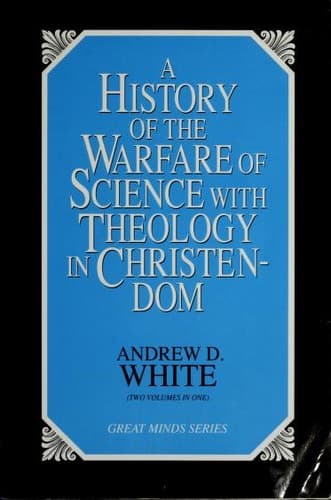
History of the Warfare of Science with Theology in ChristendomWhite, Andrew Dickson
Religion
History of the Warfare of Science with Theology in Christendom
White, Andrew Dickson
Religion and science -- History
Bayle's whole argument is rooted in the prophecy of Seneca. He declares:
"Comets are bodies subject to the ordinary law of Nature, and not
prodigies amenable to no law." He shows historically that there is no
reason to regard comets as portents of earthly evils. As to the fact
that such evils occur after the passage of comets across the sky, he
compares the person believing that comets cause these evils to a woman
looking out of a window into a Paris street and believing that the
carriages pass because she looks out. As to the accomplishment of some
predictions, he cites the shrewd saying of Henry IV, to the effect that
"the public will remember one prediction that comes true better than all
the rest that have proved false." Finally, he sums up by saying: "The
more we study man, the more does it appear that pride is his ruling
passion, and that he affects grandeur even in his misery. Mean and
perishable creature that he is, he has been able to persuade men that he
can not die without disturbing the whole course of Nature and obliging
the heavens to put themselves to fresh expense. In order to light his
funeral pomp. Foolish and ridiculous vanity! If we had a just idea of
the universe, we should soon comprehend that the death or birth of a
prince is too insignificant a matter to stir the heavens."(117)
(117) Regarding Bayle, see Madler, Himmelskunde, vol. i, p. 327.
For special points of interest in Bayle's arguments, see his Pensees
Diverses sur les Cometes, Amsterdam, 1749, pp. 79, 102, 134, 206. For
the response to Jurieu, see the continuation des Pensees, Rotterdam,
1705; also Champion, p. 164, Lecky, ubi supra, and Guillemin, pp. 29,
30.
This great philosophic champion of right reason was followed by a
literary champion hardly less famous; for Fontenelle now gave to the
French theatre his play of The Comet, and a point of capital importance
in France was made by rendering the army of ignorance ridiculous.(118)
(118) See Fontenelle, cited by Champion, p. 167.
Such was the line of philosophic and literary attack, as developed from
Scaliger to Fontenelle. But beneath and in the midst of all of it, from
first to last, giving firmness, strength, and new sources of vitality to
it, was the steady development of scientific effort; and to the
series of great men who patiently wrought and thought out the truth by
scientific methods through all these centuries belong the honours of the
victory.
Public-domain text, read in full here on John Shaqi.
Reviews
Reviews
No reviews yet
Be the first to share your thoughts on this work.
Elsewhere in the archive
Join the Discussion
Join the discussion
Sign in to leave a comment or review.
Sign InorCreate an account