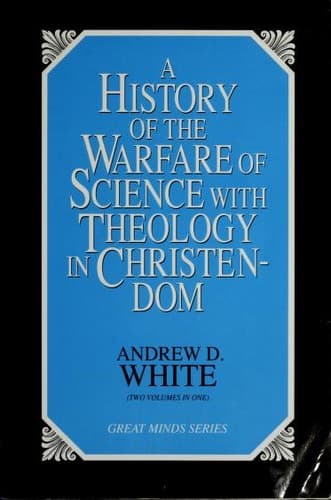
History of the Warfare of Science with Theology in ChristendomWhite, Andrew Dickson
Religion
History of the Warfare of Science with Theology in Christendom
White, Andrew Dickson
Religion and science -- History
Various astronomers laboured to develop the truth discovered by Tycho
and strengthened by Kepler. Cassini seemed likely to win for Italy the
glory of completing the great structure; but he was sadly fettered by
Church influences, and was obliged to leave most of the work to others.
Early among these was Hevel. He gave reasons for believing that comets
move in parabolic curves toward the sun. Then came a man who developed
this truth further--Samuel Doerfel; and it is a pleasure to note that
he was a clergyman. The comet of 1680, which set Erni in Switzerland,
Mather in New England, and so many others in all parts of the world
at declaiming, set Doerfel at thinking. Undismayed by the authority of
Origen and St. John Chrysostom, the arguments of Luther, Melanchthon,
and Zwingli, the outcries of Celich, Heerbrand, and Dieterich, he
pondered over the problem in his little Saxon parsonage, until in
1681 he set forth his proofs that comets are heavenly bodies moving in
parabolas of which the sun is the focus. Bernouilli arrived at the same
conclusion; and, finally, this great series of men and works was closed
by the greatest of all, when Newton, in 1686, having taken the data
furnished by the comet of 1680, demonstrated that comets are guided in
their movements by the same principle that controls the planets in their
orbits. Thus was completed the evolution of this new truth in science.
Yet we are not to suppose that these two great series of philosophical
and scientific victories cleared the field of all opponents. Declamation
and pretended demonstration of the old theologic view were still heard;
but the day of complete victory dawned when Halley, after most thorough
observation and calculation, recognised the comet of 1682 as one which
had already appeared at stated periods, and foretold its return in about
seventy-five years; and the battle was fully won when Clairaut, seconded
by Lalande and Mme. Lepaute, predicted distinctly the time when
the comet would arrive at its perihelion, and this prediction was
verified.(121) Then it was that a Roman heathen philosopher was proved
more infallible and more directly under Divine inspiration than a Roman
Christian pontiff; for the very comet which the traveller finds to-day
depicted on the Bayeux tapestry as portending destruction to Harold and
the Saxons at the Norman invasion of England, and which was regarded by
Pope Calixtus as portending evil to Christendom, was found six centuries
later to be, as Seneca had prophesied, a heavenly body obeying the great
laws of the universe, and coming at regular periods. Thenceforth the
whole ponderous enginery of this superstition, with its proof-texts
regarding "signs in the heavens," its theological reasoning to show
the moral necessity of cometary warnings, and its ecclesiastical
fulminations against the "atheism, godlessness, and infidelity" of
scientific investigation, was seen by all thinking men to be as weak
Public-domain text, read in full here on John Shaqi.
Reviews
Reviews
No reviews yet
Be the first to share your thoughts on this work.
Elsewhere in the archive
Join the Discussion
Join the discussion
Sign in to leave a comment or review.
Sign InorCreate an account