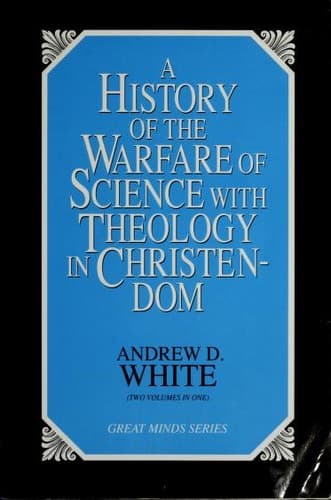
History of the Warfare of Science with Theology in ChristendomWhite, Andrew Dickson
Religion
History of the Warfare of Science with Theology in Christendom
White, Andrew Dickson
Religion and science -- History
Attempts were now made to compromise. It was declared that, while
some comets were doubtless supralunar, some must be sublunar. But this
admission was no less fatal on another account. During many centuries
the theory favoured by the Church had been, as we have seen, that the
earth was surrounded by hollow spheres, concentric and transparent,
forming a number of glassy strata incasing one another "like the
different coatings of an onion," and that each of these in its movement
about the earth carries one or more of the heavenly bodies. Some
maintained that these spheres were crystal; but Lactantius, and with him
various fathers of the Church, spoke of the heavenly vault as made of
ice. Now, the admission that comets could move beyond the moon was fatal
to this theory, for it sent them crashing through these spheres of
ice or crystal, and therefore through the whole sacred fabric of the
Ptolemaic theory.(120)
(120) For these features in cometary theory, see Pingre, vol. i, p. 89;
also Humboldt, Cosmos (English translation, London, 1868), vol. iii, p.
169.
Here we may pause for a moment to note one of the chief differences
between scientific and theological reasoning considered in themselves.
Kepler's main reasoning as to the existence of a law for cometary
movement was right; but his secondary reasoning, that comets move nearly
in straight lines, was wrong. His right reasoning was developed by
Gassendi in France, by Borelli in Italy, by Hevel and Doerfel in
Germany, by Eysat and Bernouilli in Switzerland, by Percy and--most
important of all, as regards mathematical demonstration--by Newton
in England. The general theory, which was true, they accepted and
developed; the secondary theory, which was found untrue, they rejected;
and, as a result, both of what they thus accepted and of what they
rejected, was evolved the basis of the whole modern cometary theory.
Very different was this from the theological method. As a rule, when
there arises a thinker as great in theology as Kepler in science, the
whole mass of his conclusions ripens into a dogma. His disciples labour
not to test it, but to establish it; and while, in the Catholic Church,
it becomes a dogma to be believed or disbelieved under the penalty of
damnation, it becomes in the Protestant Church the basis for one more
sect.
Public-domain text, read in full here on John Shaqi.
Reviews
Reviews
No reviews yet
Be the first to share your thoughts on this work.
Elsewhere in the archive
Join the Discussion
Join the discussion
Sign in to leave a comment or review.
Sign InorCreate an account