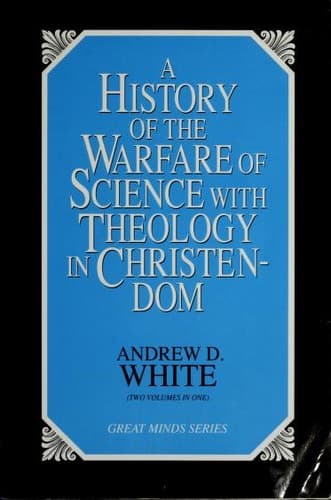
History of the Warfare of Science with Theology in ChristendomWhite, Andrew Dickson
Religion
History of the Warfare of Science with Theology in Christendom
White, Andrew Dickson
Religion and science -- History
(145) See Westminster Review, October, 1870, article on John Wesley's
Cosmogony, with citations from Wesley's Sermons, Watson's Institutes of
Theology, Adam Clarke's Commentary on the Holy Scriptures, etc.
The immediate results of such teaching by such men was to throw many who
would otherwise have resorted to observation and investigation back upon
scholastic methods. Again reappears the old system of solving the riddle
by phrases. In 1733, Dr. Theodore Arnold urged the theory of "models,"
and insisted that fossils result from "infinitesimal particles brought
together in the creation to form the outline of all the creatures
and objects upon and within the earth"; and Arnold's work gained wide
acceptance.(146)
(146) See citation in Mr. Ward's article, as above, p. 390.
Such was the influence of this succession of great men that toward the
close of the last century the English opponents of geology on biblical
grounds seemed likely to sweep all before them. Cramping our whole
inheritance of sacred literature within the rules of a historical
compend, they showed the terrible dangers arising from the revelations
of geology, which make the earth older than the six thousand years
required by Archbishop Usher's interpretation of the Old Testament.
Nor was this feeling confined to ecclesiastics. Williams, a thoughtful
layman, declared that such researches led to infidelity and atheism, and
are "nothing less than to depose the Almighty Creator of the universe
from his office." The poet Cowper, one of the mildest of men, was also
roused by these dangers, and in his most elaborate poem wrote:
"Some drill and bore
The solid earth, and from the strata there Extract a register, by
which we learn That He who made it, and revealed its date To Moses, was
mistaken in its age!"
John Howard summoned England to oppose "those scientific systems which
are calculated to tear up in the public mind every remaining attachment
to Christianity."
With this special attack upon geological science by means of the dogma
of Adam's fall, the more general attack by the literal interpretation
of the text was continued. The legendary husks and rinds of our sacred
books were insisted upon as equally precious and nutritious with the
great moral and religious truths which they envelop. Especially precious
were the six days--each "the evening and the morning"--and the exact
statements as to the time when each part of creation came into being. To
save these, the struggle became more and more desperate.
Difficult as it is to realize it now, within the memory of many now
living the battle was still raging most fiercely in England, and both
kinds of artillery usually brought against a new science were in full
play, and filling the civilized world with their roar.
Public-domain text, read in full here on John Shaqi.
Reviews
Reviews
No reviews yet
Be the first to share your thoughts on this work.
Elsewhere in the archive
Join the Discussion
Join the discussion
Sign in to leave a comment or review.
Sign InorCreate an account