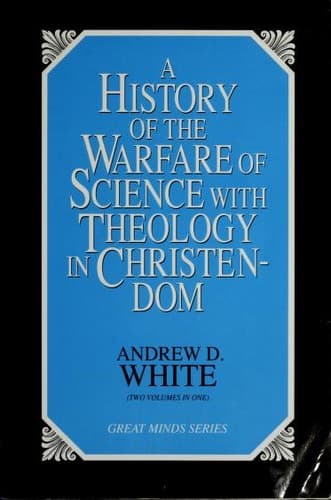
History of the Warfare of Science with Theology in ChristendomWhite, Andrew Dickson
Religion
History of the Warfare of Science with Theology in Christendom
White, Andrew Dickson
Religion and science -- History
About half a century since, the Rev. J. Mellor Brown, the Rev. Henry
Cole, and others were hurling at all geologists alike, and especially at
such Christian scholars as Dr. Buckland and Dean Conybeare and Pye Smith
and Prof. Sedgwick, the epithets of "infidel," "impugner of the sacred
record," and "assailant of the volume of God."(147)
(147) For these citations, see Lyell, Principles of Geology,
introduction.
The favourite weapon of the orthodox party was the charge that the
geologists were "attacking the truth of God." They declared geology
"not a subject of lawful inquiry," denouncing it as "a dark art," as
"dangerous and disreputable," as "a forbidden province," as
"infernal artillery," and as "an awful evasion of the testimony of
revelation."(148)
(148) See Pye Smith, D. D., Geology and Scripture, pp. 156, 157, 168,
169.
This attempt to scare men from the science having failed, various other
means were taken. To say nothing about England, it is humiliating to
human nature to remember the annoyances, and even trials, to which the
pettiest and narrowest of men subjected such Christian scholars in our
own country as Benjamin Silliman and Edward Hitchcock and Louis Agassiz.
But it is a duty and a pleasure to state here that one great Christian
scholar did honour to religion and to himself by quietly accepting
the claims of science and making the best of them, despite all these
clamours. This man was Nicholas Wiseman, better known afterward as
Cardinal Wiseman. The conduct of this pillar of the Roman Catholic
Church contrasts admirably with that of timid Protestants, who were
filling England with shrieks and denunciations.(149)
(149) Wiseman, Twelve Lectures on the Connection between Science and
Revealed Religion, first American edition, New York, 1837. As to the
comparative severity of the struggle regarding astronomy, geology, etc.,
in the Catholic and Protestant countries, see Lecky's England in the
Eighteenth Century, chap. ix, p. 525.
And here let it be noted that one of the most interesting skirmishes
in this war occurred in New England. Prof. Stuart, of Andover, justly
honoured as a Hebrew scholar, declared that to speak of six periods of
time for the creation was flying in the face of Scripture; that Genesis
expressly speaks of six days, each made up of "the evening and the
morning," and not six periods of time.
To him replied a professor in Yale College, James Kingsley. In an
article admirable for keen wit and kindly temper, he showed that Genesis
speaks just as clearly of a solid firmament as of six ordinary days,
and that, if Prof. Stuart had surmounted one difficulty and accepted
the Copernican theory, he might as well get over another and accept the
revelations of geology. The encounter was quick and decisive, and the
victory was with science and the broader scholarship of Yale.(150)
(150) See Silliman's Journal, vol. xxx, p. 114.
Public-domain text, read in full here on John Shaqi.
Reviews
Reviews
No reviews yet
Be the first to share your thoughts on this work.
Elsewhere in the archive
Join the Discussion
Join the discussion
Sign in to leave a comment or review.
Sign InorCreate an account