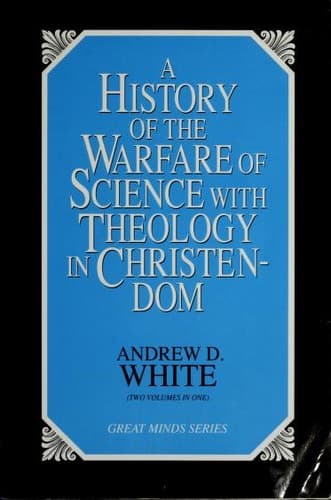
History of the Warfare of Science with Theology in ChristendomWhite, Andrew Dickson
Religion
History of the Warfare of Science with Theology in Christendom
White, Andrew Dickson
Religion and science -- History
Perhaps the most singular attempt against geology was made by a fine
survival of the eighteenth century Don--Dean Cockburn, of York--to SCOLD
its champions off the field. Having no adequate knowledge of the new
science, he opened a battery of abuse, giving it to the world at large
from the pulpit and through the press, and even through private letters.
From his pulpit in York Minster he denounced Mary Somerville by name for
those studies in physical geography which have made her name honoured
throughout the world.
But the special object of his antipathy was the British Association for
the Advancement of Science. He issued a pamphlet against it which
went through five editions in two years, sent solemn warnings to its
president, and in various ways made life a burden to Sedgwick, Buckland,
and other eminent investigators who ventured to state geological facts
as they found them.
These weapons were soon seen to be ineffective; they were like Chinese
gongs and dragon lanterns against rifled cannon; the work of science
went steadily on.(151)
(151) Prof. Goldwin Smith informs me that the papers of Sir Robert Peel,
yet unpublished, contain very curious specimens of the epistles of Dean
Cockburn. See also Personal Recollections of Mary Somerville, Boston,
1874, pp. 139 and 375. Compare with any statement of his religious views
that Dean Cockburn was able to make, the following from Mrs. Somerville:
"Nothing has afforded me so convincing a proof of the Deity as these
purely mental conceptions of numerical and mathematical science which
have been, by slow degrees, vouchsafed to man--and are still granted
in these latter times by the differential calculus, now superseded by
the higher algebra--all of which must have existed in that sublimely
omniscient mind from eternity." See also The Life and Letters of Adam
Sedgwick, Cambridge, 1890, vol. ii, pp. 76 and following.
III. THE FIRST GREAT EFFORT AT COMPROMISE, BASED ON THE FLOOD OF NOAH.
Long before the end of the struggle already described, even at a very
early period, the futility of the usual scholastic weapons had been
seen by the more keen-sighted champions of orthodoxy; and, as the
difficulties of the ordinary attack upon science became more and more
evident, many of these champions endeavoured to patch up a truce. So
began the third stage in the war--the period of attempts at compromise.
The position which the compromise party took was that the fossils were
produced by the Deluge of Noah.
This position was strong, for it was apparently based upon Scripture.
Moreover, it had high ecclesiastical sanction, some of the fathers
having held that fossil remains, even on the highest mountains,
represented animals destroyed at the Deluge. Tertullian was especially
firm on this point, and St. Augustine thought that a fossil tooth
discovered in North Africa must have belonged to one of the giants
mentioned in Scripture.(152)
Public-domain text, read in full here on John Shaqi.
Reviews
Reviews
No reviews yet
Be the first to share your thoughts on this work.
Elsewhere in the archive
Join the Discussion
Join the discussion
Sign in to leave a comment or review.
Sign InorCreate an account