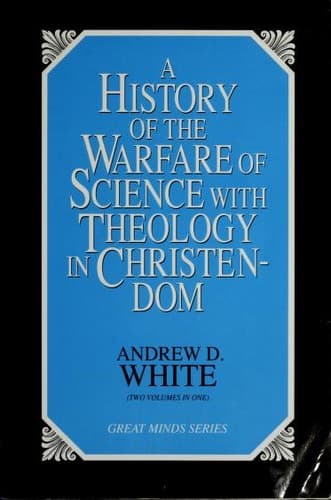
History of the Warfare of Science with Theology in ChristendomWhite, Andrew Dickson
Religion
History of the Warfare of Science with Theology in Christendom
White, Andrew Dickson
Religion and science -- History
About the year 1760 news of the discovery of marine fossils in various
elevated districts of Europe reached Voltaire. He, too, had a theologic
system to support, though his system was opposed to that of the sacred
books of the Hebrews; and, fearing that these new discoveries might be
used to support the Mosaic accounts of the Deluge, all his wisdom and
wit were compacted into arguments to prove that the fossil fishes were
remains of fishes intended for food, but spoiled and thrown away
by travellers; that the fossil shells were accidentally dropped by
crusaders and pilgrims returning from the Holy Land; and that the fossil
bones found between Paris and Etampes were parts of a skeleton belonging
to the cabinet of some ancient philosopher. Through chapter after
chapter, Voltaire, obeying the supposed necessities of his theology,
fought desperately the growing results of the geologic investigations of
his time.(159)
(159) See Voltaire, Dissertation sur les Changements arrives dans notre
Globe; also Voltaire, Les Singularities de la Nature, chap. xii; also
Jevons, Principles of Science, vol. ii, p. 328.
But far more prejudicial to Christianity was the continued effort on the
other side to show that the fossils were caused by the Deluge of Noah.
No supposition was too violent to support this theory, which was
considered vital to the Bible. By taking the mere husks and rinds of
biblical truth for truth itself, by taking sacred poetry as prose,
and by giving a literal interpretation of it, the followers of Burnet,
Whiston, and Woodward built up systems which bear to real geology much
the same relation that the Christian Topography of Cosmas bears to real
geography. In vain were exhibited the absolute geological, zoological,
astronomical proofs that no universal deluge, or deluge covering any
large part of the earth, had taken place within the last six thousand or
sixty thousand years; in vain did so enlightened a churchman as Bishop
Clayton declare that the Deluge could not have extended beyond that
district where Noah lived before the Flood; in vain did others, like
Bishop Croft and Bishop Stillingfleet, and the nonconformist Matthew
Poole, show that the Deluge might not have been and probably was not
universal; in vain was it shown that, even if there had been a universal
deluge, the fossils were not produced by it: the only answers were the
citation of the text, "And all the high mountains which were under the
whole heaven were covered," and, to clinch the matter, Worthington and
men like him insisted that any argument to show that fossils were not
remains of animals drowned at the Deluge of Noah was "infidelity." In
England, France, and Germany, belief that the fossils were produced
by the Deluge of Noah was widely insisted upon as part of that faith
essential to salvation.(160)
Public-domain text, read in full here on John Shaqi.
Reviews
Reviews
No reviews yet
Be the first to share your thoughts on this work.
Elsewhere in the archive
Join the Discussion
Join the discussion
Sign in to leave a comment or review.
Sign InorCreate an account