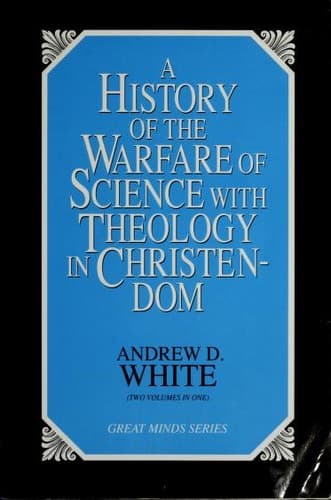
History of the Warfare of Science with Theology in ChristendomWhite, Andrew Dickson
Religion
History of the Warfare of Science with Theology in Christendom
White, Andrew Dickson
Religion and science -- History
(160) For a candid summary of the proofs from geology, astronomy,
and zoology, that the Noachian Deluge was not universally or widely
extended, see McClintock and Strong, Cyclopedia of Biblical Theology
and Ecclesiastical Literature, article Deluge. For general history, see
Lyell, D'Archiac, and Vezian. For special cases showing the bitterness
of the conflict, see the Rev. Mr. Davis's Life of Rev. Dr. Pye Smith,
passim. For a late account, see Prof. Huxley on The Lights of the Church
and the Light of Science, in the Nineteenth Century for July, 1890.
But the steady work of science went on: not all the force of the
Church--not even the splendid engravings in Scheuchzer's Bible--could
stop it, and the foundations of this theological theory began to crumble
away. The process was, indeed, slow; it required a hundred and twenty
years for the searchers of God's truth, as revealed in Nature--such men
as Hooke, Linnaeus, Whitehurst, Daubenton, Cuvier, and William Smith--to
push their works under this fabric of error, and, by statements which
could not be resisted, to undermine it. As we arrive at the beginning of
the nineteenth century, science is becoming irresistible in this field.
Blumenbach, Von Buch, and Schlotheim led the way, but most important on
the Continent was the work of Cuvier. In the early years of the present
century his researches among fossils began to throw new light into the
whole subject of geology. He was, indeed, very conservative, and even
more wary and diplomatic; seeming, like Voltaire, to feel that "among
wolves one must howl a little." It was a time of reaction. Napoleon
had made peace with the Church, and to disturb that peace was akin to
treason. By large but vague concessions Cuvier kept the theologians
satisfied, while he undermined their strongest fortress. The danger was
instinctively felt by some of the champions of the Church, and typical
among these was Chateaubriand, who in his best-known work, once so
great, now so little--the Genius of Christianity--grappled with the
questions of creation by insisting upon a sort of general deception "in
the beginning," under which everything was created by a sudden fiat,
but with appearances of pre-existence. His words are as follows: "It
was part of the perfection and harmony of the nature which was displayed
before men's eyes that the deserted nests of last year's birds should be
seen on the trees, and that the seashore should be covered with shells
which had been the abode of fish, and yet the world was quite new, and
nests and shells had never been inhabited."(161) But the real victory
was with Brongniart, who, about 1820, gave forth his work on fossil
plants, and thus built a barrier against which the enemies of science
raged in vain.(162)
(161) Genie du Christianisme, chap.v, pp. 1-14, cited by Reusch, vol. i,
p. 250.
(162) For admirable sketches of Brongniart and other paleobotanists, see
Ward, as above.
Public-domain text, read in full here on John Shaqi.
Reviews
Reviews
No reviews yet
Be the first to share your thoughts on this work.
Elsewhere in the archive
Join the Discussion
Join the discussion
Sign in to leave a comment or review.
Sign InorCreate an account