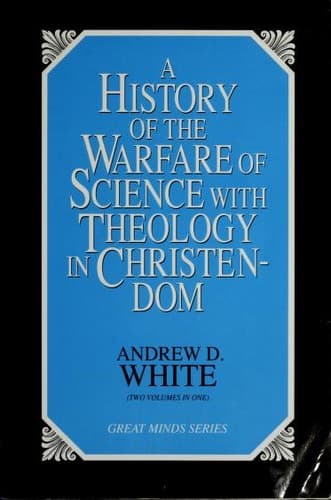
History of the Warfare of Science with Theology in ChristendomWhite, Andrew Dickson
Religion
History of the Warfare of Science with Theology in Christendom
White, Andrew Dickson
Religion and science -- History
In the great ranges of investigation which bear most directly upon the
origin of man, there are two in which Science within the last few years
has gained final victories. The significance of these in changing, and
ultimately in reversing, one of the greatest currents of theological
thought, can hardly be overestimated; not even the tide set in motion by
Cusa, Copernicus, and Galileo was more powerful to bring in a new epoch
of belief.
The first of these conquests relates to the antiquity of man on the
earth.
The fathers of the early Christian Church, receiving all parts of our
sacred books as equally inspired, laid little, if any, less stress
on the myths, legends, genealogies, and tribal, family, and personal
traditions contained in the Old and the New Testaments, than upon the
most powerful appeals, the most instructive apologues, and the most
lofty poems of prophets, psalmists, and apostles. As to the age of our
planet and the life of man upon it, they found in the Bible a carefully
recorded series of periods, extending from Adam to the building of the
Temple at Jerusalem, the length of each period being explicitly given.
Thus they had a biblical chronology--full, consecutive, and
definite--extending from the first man created to an event of known
date well within ascertained profane history; as a result, the early
Christian commentators arrived at conclusions varying somewhat, but in
the main agreeing. Some, like Origen, Eusebius, Lactantius, Clement
of Alexandria, and the great fathers generally of the first three
centuries, dwelling especially upon the Septuagint version of the
Scriptures, thought that man's creation took place about six thousand
years before the Christian era. Strong confirmation of this view was
found in a simple piece of purely theological reasoning: for, just as
the seven candlesticks of the Apocalypse were long held to prove the
existence of seven heavenly bodies revolving about the earth, so it was
felt that the six days of creation prefigured six thousand years during
which the earth in its first form was to endure; and that, as the first
Adam came on the sixth day, Christ, the second Adam, had come at the
sixth millennial period. Theophilus, Bishop of Antioch, in the second
century clinched this argument with the text, "One day is with the Lord
as a thousand years."
On the other hand, Eusebius and St. Jerome, dwelling more especially
upon the Hebrew text, which we are brought up to revere, thought
that man's origin took place at a somewhat shorter period before the
Christian era; and St. Jerome's overwhelming authority made this the
dominant view throughout western Europe during fifteen centuries.
Public-domain text, read in full here on John Shaqi.
Reviews
Reviews
No reviews yet
Be the first to share your thoughts on this work.
Elsewhere in the archive
Join the Discussion
Join the discussion
Sign in to leave a comment or review.
Sign InorCreate an account