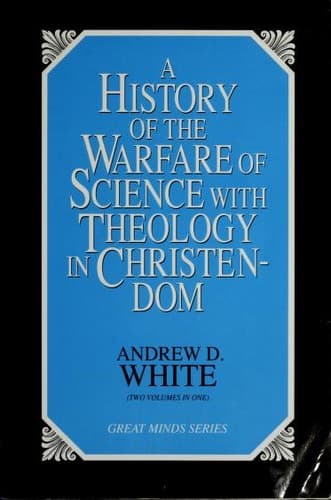
History of the Warfare of Science with Theology in ChristendomWhite, Andrew Dickson
Religion
History of the Warfare of Science with Theology in Christendom
White, Andrew Dickson
Religion and science -- History
The simplicity of these great fathers as regards chronology is
especially reflected from the tables of Eusebius. In these, Moses,
Joshua, and Bacchus,--Deborah, Orpheus, and the Amazons,--Abimelech,
the Sphinx, and Oedipus, appear together as personages equally real, and
their positions in chronology equally ascertained.
At times great bitterness was aroused between those holding the longer
and those holding the shorter chronology, but after all the difference
between them, as we now see, was trivial; and it may be broadly stated
that in the early Church, "always, everywhere, and by all," it was held
as certain, upon the absolute warrant of Scripture, that man was created
from four to six thousand years before the Christian era.
To doubt this, and even much less than this, was to risk damnation.
St. Augustine insisted that belief in the antipodes and in the longer
duration of the earth than six thousand years were deadly heresies,
equally hostile to Scripture. Philastrius, the friend of St. Ambrose and
St. Augustine, whose fearful catalogue of heresies served as a guide
to intolerance throughout the Middle Ages, condemned with the same holy
horror those who expressed doubt as to the orthodox number of years
since the beginning of the world, and those who doubted an earthquake to
be the literal voice of an angry God, or who questioned the plurality of
the heavens, or who gainsaid the statement that God brings out the stars
from his treasures and hangs them up in the solid firmament above the
earth every night.
About the beginning of the seventh century Isidore of Seville, the great
theologian of his time, took up the subject. He accepted the dominant
view not only of Hebrew but of all other chronologies, without anything
like real criticism. The childlike faith of his system may be imagined
from his summaries which follow. He tells us:
"Joseph lived one hundred and five years. Greece began to cultivate
grain."
"The Jews were in slavery in Egypt one hundred and forty-four years.
Atlas discovered astrology."
"Joshua ruled for twenty-seven years. Ericthonius yoked horses
together."
"Othniel, forty years. Cadmus introduced letters into Greece."
"Deborah, forty years. Apollo discovered the art of medicine and
invented the cithara."
"Gideon, forty years. Mercury invented the lyre and gave it to Orpheus."
Reasoning in this general way, Isidore kept well under the longer date;
and, the great theological authority of southern Europe having thus
spoken, the question was virtually at rest throughout Christendom for
nearly a hundred years.
Public-domain text, read in full here on John Shaqi.
Reviews
Reviews
No reviews yet
Be the first to share your thoughts on this work.
Elsewhere in the archive
Join the Discussion
Join the discussion
Sign in to leave a comment or review.
Sign InorCreate an account