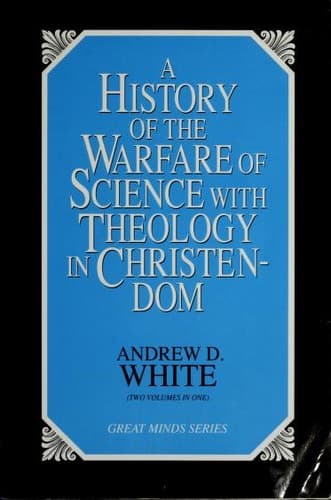
History of the Warfare of Science with Theology in ChristendomWhite, Andrew Dickson
Religion
History of the Warfare of Science with Theology in Christendom
White, Andrew Dickson
Religion and science -- History
Take, next, astronomy. Going back to the very earliest period of
Egyptian civilization, we find that the four sides of the Great Pyramid
are adjusted to the cardinal points with the utmost precision. "The day
of the equinox can be taken by observing the sun set across the face of
the pyramid, and the neighbouring Arabs adjust their astronomical dates
by its shadow." Yet this is but one out of many facts which prove that
the Egyptians, at the earliest period of which their monuments exist,
had arrived at knowledge and skill only acquired by long ages of
observation and thought. Mr. Lockyer, Astronomer Royal of Great Britain,
has recently convinced himself, after careful examination of various
ruined temples at Thebes and elsewhere, that they were placed with
reference to observations of stars. To state his conclusion in his own
words: "There seems a very high probability that three thousand, and
possibly four thousand, years before Christ the Egyptians had among them
men with some knowledge of astronomy, and that six thousand years ago
the course of the sun through the year was practically very well known,
and methods had been invented by means of which in time it might
be better known; and that, not very long after that, they not only
considered questions relating to the sun, but began to take up other
questions relating to the position and movement of the stars."
The same view of the antiquity of man in the Nile valley is confirmed by
philologists. To use the words of Max Duncker: "The oldest monuments
of Egypt--and they are the oldest monuments in the world--exhibit the
Egyptian in possession of the art of writing." It is found also, by the
inscriptions of the early dynasties, that the Egyptian language had even
at that early time been developed in all essential particulars to the
highest point it ever attained. What long periods it must have required
for such a development every scholar in philology can imagine.
As regards medical science, we have the Berlin papyrus, which, although
of a later period, refers with careful specification to a medical
literature of the first dynasty.
As regards archaeology, the earliest known inscriptions point to still
earlier events and buildings, indicating a long sequence in previous
history.
Public-domain text, read in full here on John Shaqi.
Reviews
Reviews
No reviews yet
Be the first to share your thoughts on this work.
Elsewhere in the archive
Join the Discussion
Join the discussion
Sign in to leave a comment or review.
Sign InorCreate an account