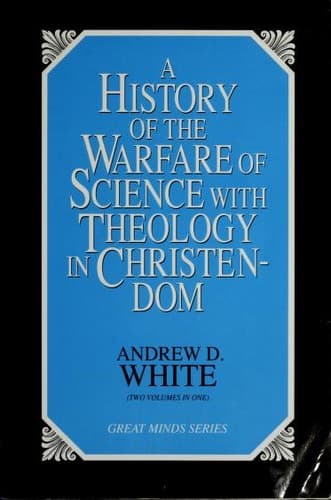
History of the Warfare of Science with Theology in ChristendomWhite, Andrew Dickson
Religion
History of the Warfare of Science with Theology in Christendom
White, Andrew Dickson
Religion and science -- History
(188) As to the evidence of man in the Tertiary period, see works
already cited, especially Quatrefages, Cartailhac, and Mortillet. For an
admirable summary, see Laing, Human Origins, chap. viii. See also, for
a summing up of the evidence in favour of man in the Tertiary period,
Quatrefages, History Generale des Races Humaines, in the Bibliotheque
Ethnologique, Paris, 1887, chap. iv. As to the earlier view, see Vogt,
Lectures on Man, London, 1864, lecture xi. For a thorough and convincing
refutation of Sir J. W. Dawson's attempt to make the old and new Stone
periods coincide, see H. W. Haynes, in chap. vi of the History of
America, edited by Justin Winsor. For development of various important
points in the relation of anthropology to the human occupancy of our
planet, see Topinard, Anthropology, London, 1890, chap. ix.
CHAPTER VIII. THE "FALL OF MAN" AND ANTHROPOLOGY
In the previous chapters we have seen how science, especially within
the eighteenth and nineteenth centuries, has thoroughly changed the
intelligent thought of the world in regard to the antiquity of man upon
our planet; and how the fabric built upon the chronological indications
in our sacred books--first, by the early fathers of the Church,
afterward by the medieval doctors, and finally by the reformers and
modern orthodox chronologists--has virtually disappeared before an
entirely different view forced upon us, especially by Egyptian and
Assyrian studies, as well as by geology and archeology.
In this chapter I purpose to present some outlines of the work of
Anthropology, especially as assisted by Ethnology, in showing what the
evolution of human civilization has been.
Here, too, the change from the old theological view based upon the
letter of our sacred books to the modern scientific view based upon
evidence absolutely irrefragable is complete. Here, too, we are at the
beginning of a vast change in the basis and modes of thought upon man--a
change even more striking than that accomplished by Copernicus and
Galileo, when they substituted for a universe in which sun and planets
revolved about the earth a universe in which the earth is but the merest
grain or atom revolving with other worlds, larger and smaller, about the
sun; and all these forming but one among innumerable systems.
Ever since the beginning of man's effective thinking upon the great
problems around him, two antagonistic views have existed regarding the
life of the human race upon earth. The first of these is the belief that
man was created "in the beginning" a perfect being, endowed with the
highest moral and intellectual powers, but that there came a "fall,"
and, as its result, the entrance into the world of evil, toil, sorrow,
and death.
Public-domain text, read in full here on John Shaqi.
Reviews
Reviews
No reviews yet
Be the first to share your thoughts on this work.
Elsewhere in the archive
Join the Discussion
Join the discussion
Sign in to leave a comment or review.
Sign InorCreate an account