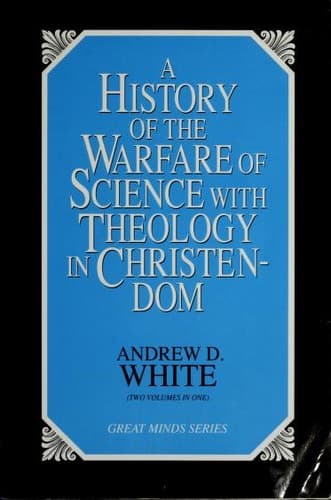
History of the Warfare of Science with Theology in ChristendomWhite, Andrew Dickson
Religion
History of the Warfare of Science with Theology in Christendom
White, Andrew Dickson
Religion and science -- History
Nothing could be more natural than such an explanation of the existence
of evil, in times when men saw everywhere miracle and nowhere law. It
is, under such circumstances, by far the most easy of explanations, for
it is in accordance with the appearances of things: men adopted it just
as naturally as they adopted the theory that the Almighty hangs up the
stars as lights in the solid firmament above the earth, or hides the sun
behind a mountain at night, or wheels the planets around the earth, or
flings comets as "signs and wonders" to scare a wicked world, or allows
evil spirits to control thunder, lightning, and storm, and to cause
diseases of body and mind, or opens the "windows of heaven" to let down
"the waters that be above the heavens," and thus to give rain upon the
earth.
A belief, then, in a primeval period of innocence and perfection--moral,
intellectual, and physical--from which men for some fault fell, is
perfectly in accordance with what we should expect.
Among the earliest known records of our race we find this view taking
shape in the Chaldean legends of war between the gods, and of a fall of
man; both of which seemed necessary to explain the existence of evil.
In Greek mythology perhaps the best-known statement was made by Hesiod:
to him it was revealed, regarding the men of the most ancient times,
that they were at first "a golden race," that "as gods they were wont
to live, with a life void of care, without labour and trouble; nor was
wretched old age at all impending; but ever did they delight themselves
out of the reach of all ills, and they died as if overcome by sleep;
all blessings were theirs: of its own will the fruitful field would bear
them fruit, much and ample, and they gladly used to reap the labours
of their hands in quietness along with many good things, being rich in
flocks and true to the blessed gods." But there came a "fall," caused
by human curiosity. Pandora, the first woman created, received a vase
which, by divine command, was to remain closed; but she was tempted to
open it, and troubles, sorrow, and disease escaped into the world, hope
alone remaining.
So, too, in Roman mythological poetry the well-known picture by Ovid
is but one among the many exhibitions of this same belief in a primeval
golden age--a Saturnian cycle; one of the constantly recurring attempts,
so universal and so natural in the early history of man, to account for
the existence of evil, care, and toil on earth by explanatory myths and
legends.
Public-domain text, read in full here on John Shaqi.
Reviews
Reviews
No reviews yet
Be the first to share your thoughts on this work.
Elsewhere in the archive
Join the Discussion
Join the discussion
Sign in to leave a comment or review.
Sign InorCreate an account