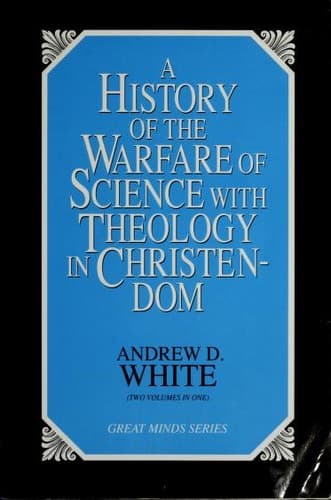
History of the Warfare of Science with Theology in ChristendomWhite, Andrew Dickson
Religion
History of the Warfare of Science with Theology in Christendom
White, Andrew Dickson
Religion and science -- History
The investigations of the last forty years have shown that Lucretius and
Horace were inspired prophets: what they saw by the exercise of reason
illumined by poetic genius, has been now thoroughly based upon facts
carefully ascertained and arranged--until Thomsen and Nilsson, the
northern archaeologists, have brought these prophecies to evident
fulfilment, by presenting a scientific classification dividing the age
of prehistoric man in various parts of the world between an old stone
period, a new stone period, a period of beaten copper, a period of
bronze, and a period of iron, and arraying vast masses of facts from all
parts of the world, fitting thoroughly into each other, strengthening
each other, and showing beyond a doubt that, instead of a FALL, there
has been a RISE of man, from the earliest indications in the Quaternary,
or even, possibly, in the Tertiary period.(190)
(190) For Vanini, see Topinard, Elements of Anthropologie, p. 52. For a
brief and careful summary of the agency of Eccard in Germany, Goguet
in France, Hoare in England, and others in various parts of Europe, as
regards this development of the scientific view during the eighteenth
century, see Mortillet, Le Prehistorique, Paris, 1885, chap. i. For the
agency of Bodin, Bacon, Descartes, and Pascal, see Flint, Philosophy
of History, introduction, pp. 28 et seq. For a shorter summary,
see Lubbock, Prehistoric Man. For the statements by the northern
archaeologists, see Nilsson, Worsaae, and the other main works cited in
this article. For a generous statement regarding the great services of
the Danish archaeologists in this field, see Quatrefages, introduction
to Cartailhac, Les Ages Prehistoriques de l'Espagne et du Portugal.
The first blow at the fully developed doctrine of "the Fall" came, as
we have seen, from geology. According to that doctrine, as held quite
generally from its beginnings among the fathers and doctors of
the primitive Church down to its culmination in the minds of great
Protestants like John Wesley, the statement in our sacred books
that "death entered the world by sin" was taken as a historic fact,
necessitating the conclusion that, before the serpent persuaded Eve to
eat of the forbidden fruit, death on our planet was unknown. Naturally,
when geology revealed, in the strata of a period long before the coming
of man on earth, a vast multitude of carnivorous tribes fitted
to destroy their fellow-creatures on land and sea, and within the
fossilized skeletons of many of these the partially digested remains of
animals, this doctrine was too heavy to be carried, and it was quietly
dropped.
Public-domain text, read in full here on John Shaqi.
Reviews
Reviews
No reviews yet
Be the first to share your thoughts on this work.
Elsewhere in the archive
Join the Discussion
Join the discussion
Sign in to leave a comment or review.
Sign InorCreate an account