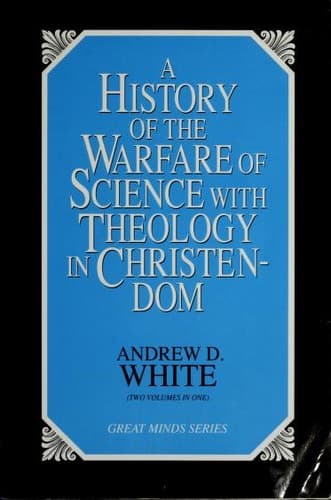
History of the Warfare of Science with Theology in ChristendomWhite, Andrew Dickson
Religion
History of the Warfare of Science with Theology in Christendom
White, Andrew Dickson
Religion and science -- History
(189) For the passage in Hesiod, as given, see the Works and Days, lines
109-120, in Banks's translation. As to Horace, see the Satires, i, 3,
99. As to the relation of the poetic account of the Fall in Genesis to
Chaldean myths, see Smith, Chaldean Account of Genesis, pp. 13, 17. For
a very instructive separation of the Jehovistic and Elohistic parts
of Genesis, with the account of the "Fall" as given in the former, see
Lenormant, La Genese, Paris, 1883, pp. 166-168; also Bacon, Genesis of
Genesis. Of the lines of Lucretius--
"Arma antiqua, manus, ungues, dentesque fuerunt, Et lapides, et item
sylvarum fragmina rami, Posterius ferri vis est, aerisque reperta, Sed
prior aeris erat, quam ferri cognitus usus"---
the translation is that of Good. For a more exact prose translation, see
Munro's Lucretius, fourth edition, which is much more careful, at least
in the proof-reading, than the first edition. As regards Lucretius's
propheitc insight into some of the greatest conclusions of modern
science, see Munro's translation and notes, fourth edition, book v,
notes ii, p. 335. On the relation of several passages in Horace to the
ideas of Lucretius, see Munro as above. For the passage from Luther, see
the Table Talk, Hazlitt's translation, p. 242.
During the mediaeval ages of faith this view was almost entirely
obscured, and at the Reformation it seemed likely to remain so. Typical
of the simplicity of belief in "the Fall" cherished among the Reformers
is Luther's declaration regarding Adam and Eve. He tells us, "they
entered into the garden about noon, and having a desire to eat, she took
the apple; then came the fall--according to our account at about
two o'clock." But in the revival of learning the old eclipsed truth
reappeared, and in the first part of the seventeenth century we find
that, among the crimes for which Vanini was sentenced at Toulouse to
have his tongue torn out and to be burned alive, was his belief that
there is a gradation extending upward from the lowest to the highest
form of created beings.
Yet, in the same century, the writings of Bodin, Bacon, Descartes, and
Pascal were evidently undermining the old idea of "the Fall." Bodin
especially, brilliant as were his services to orthodoxy, argued lucidly
against the doctrine of general human deterioration.
Early in the eighteenth century Vico presented the philosophy of history
as an upward movement of man out of animalism and barbarism. This idea
took firm hold upon human thought, and in the following centuries such
men as Lessing and Turgot gave new force to it.
Public-domain text, read in full here on John Shaqi.
Reviews
Reviews
No reviews yet
Be the first to share your thoughts on this work.
Elsewhere in the archive
Join the Discussion
Join the discussion
Sign in to leave a comment or review.
Sign InorCreate an account