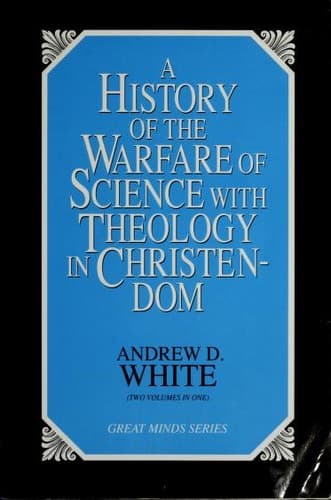
History of the Warfare of Science with Theology in ChristendomWhite, Andrew Dickson
Religion
History of the Warfare of Science with Theology in Christendom
White, Andrew Dickson
Religion and science -- History
Throughout the theological world there was an outcry at once against
"atheism," and war raged fiercely. Herschel and others pointed out
many nebulous patches apparently gaseous. They showed by physical and
mathematical demonstrations that the hypothesis accounted for the great
body of facts, and, despite clamour, were gaining ground, when the
improved telescopes resolved some of the patches of nebulous matter
into multitudes of stars. The opponents of the nebular hypothesis were
overjoyed; they now sang paeans to astronomy, because, as they said,
it had proved the truth of Scripture. They had jumped to the conclusion
that all nebula must be alike; that, if SOME are made up of systems of
stars, ALL must be so made up; that none can be masses of attenuated
gaseous matter, because some are not.
Science halted for a time. The accepted doctrine became this: that the
only reason why all the nebula are not resolved into distinct stars is
that our telescopes are not sufficiently powerful. But in time came
the discovery of the spectroscope and spectrum analysis, and thence
Fraunhofer's discovery that the spectrum of an ignited gaseous body is
non-continuous, with interrupting lines; and Draper's discovery that the
spectrum of an ignited solid is continuous, with no interrupting lines.
And now the spectroscope was turned upon the nebula, and many of them
were found to be gaseous. Here, then, was ground for the inference
that in these nebulous masses at different stages of condensation--some
apparently mere pitches of mist, some with luminous centres--we have the
process of development actually going on, and observations like those of
Lord Rosse and Arrest gave yet further confirmation to this view. Then
came the great contribution of the nineteenth century to physics, aiding
to explain important parts of the vast process by the mechanical theory
of heat.
Again the nebular hypothesis came forth stronger than ever, and about
1850 the beautiful experiment of Plateau on the rotation of a fluid
globe came in apparently to illustrate if not to confirm it. Even so
determined a defender of orthodoxy as Mr. Gladstone at last acknowledged
some form of a nebular hypothesis as probably true.
Public-domain text, read in full here on John Shaqi.
Reviews
Reviews
No reviews yet
Be the first to share your thoughts on this work.
Join the Discussion
Join the discussion
Sign in to leave a comment or review.
Sign InorCreate an account