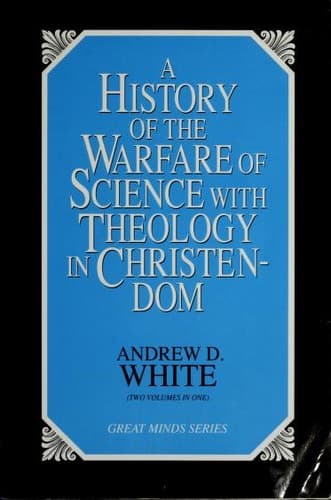
History of the Warfare of Science with Theology in ChristendomWhite, Andrew Dickson
Religion
History of the Warfare of Science with Theology in Christendom
White, Andrew Dickson
Religion and science -- History
(18) For Acosta, see his Historia Natural y moral de las Indias,
Seville, 1590--the quaint English translation is of London, 1604; for
Abraham Milius, see his De Origine Animalium et Migratione Popularum,
Geneva, 1667; also Kosmos, 1877, H. I, S. 36; for Linnaeus's declaration
regarding species, see the Philosophia Botanica, 99, 157; for Calmet and
Linnaeus, see Zoeckler, vol. ii, p. 237. As to the enormously increasing
numbers of species in zoology and botany, see President D. S. Jordan,
Science Sketches, pp. 176, 177; also for pithy statement, Laing's
Problems of the Future, chap. vi.
III. THEOLOGICAL AND SCIENTIFIC THEORIES, OF AN EVOLUTION IN ANIMATED
NATURE.
We have seen, thus far, how there came into the thinking of mankind
upon the visible universe and its inhabitants the idea of a creation
virtually instantaneous and complete, and of a Creator in human form
with human attributes, who spoke matter into existence literally by the
exercise of his throat and lips, or shaped and placed it with his hands
and fingers.
We have seen that this view came from far; that it existed in the
Chaldaeo-Babylonian and Egyptian civilizations, and probably in others
of the earliest date known to us; that its main features passed thence
into the sacred books of the Hebrews and then into the early Christian
Church, by whose theologians it was developed through the Middle Ages
and maintained during the modern period.
But, while this idea was thus developed by a succession of noble and
thoughtful men through thousands of years, another conception, to all
appearance equally ancient, was developed, sometimes in antagonism to
it, sometimes mingled with it--the conception of all living beings as
wholly or in part the result of a growth process--of an evolution.
This idea, in various forms, became a powerful factor in nearly all the
greater ancient theologies and philosophies. For very widespread among
the early peoples who attained to much thinking power was a conception
that, in obedience to the divine fiat, a watery chaos produced the
earth, and that the sea and land gave birth to their inhabitants.
This is clearly seen in those records of Chaldaeo-Babylonian thought
deciphered in these latter years, to which reference has already been
made. In these we have a watery chaos which, under divine action, brings
forth the earth and its inhabitants; first the sea animals and then the
land animals--the latter being separated into three kinds, substantially
as recorded afterward in the Hebrew accounts. At the various stages in
the work the Chaldean Creator pronounces it "beautiful," just as the
Hebrew Creator in our own later account pronounces it "good."
Public-domain text, read in full here on John Shaqi.
Reviews
Reviews
No reviews yet
Be the first to share your thoughts on this work.
Elsewhere in the archive
Join the Discussion
Join the discussion
Sign in to leave a comment or review.
Sign InorCreate an account