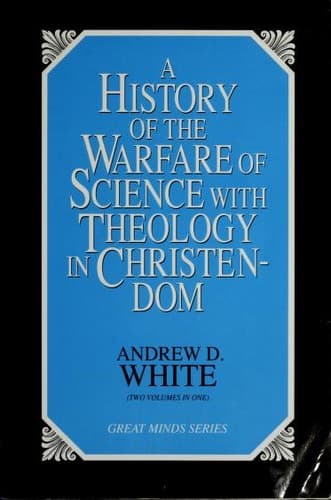
History of the Warfare of Science with Theology in ChristendomWhite, Andrew Dickson
Religion
History of the Warfare of Science with Theology in Christendom
White, Andrew Dickson
Religion and science -- History
In both accounts there is placed over the whole creation a solid,
concave firmament; in both, light is created first, and the heavenly
bodies are afterward placed "for signs and for seasons"; in both, the
number seven is especially sacred, giving rise to a sacred division of
time and to much else. It may be added that, with many other features in
the Hebrew legends evidently drawn from the Chaldean, the account of the
creation in each is followed by a legend regarding "the fall of man" and
a deluge, many details of which clearly passed in slightly modified form
from the Chaldean into the Hebrew accounts.
It would have been a miracle indeed if these primitive conceptions,
wrought out with so much poetic vigour in that earlier civilization
on the Tigris and Euphrates, had failed to influence the Hebrews, who
during the most plastic periods of their development were under the
tutelage of their Chaldean neighbours. Since the researches of Layard,
George Smith, Oppert, Schrader, Jensen, Sayce, and their compeers, there
is no longer a reasonable doubt that this ancient view of the world,
elaborated if not originated in that earlier civilization, came thence
as a legacy to the Hebrews, who wrought it in a somewhat disjointed but
mainly monotheistic form into the poetic whole which forms one of the
most precious treasures of ancient thought preserved in the book of
Genesis.
Thus it was that, while the idea of a simple material creation literally
by the hands and fingers or voice of the Creator became, as we have
seen, the starting-point of a powerful stream of theological thought,
and while this stream was swollen from age to age by contributions from
the fathers, doctors, and learned divines of the Church, Catholic
and Protestant, there was poured into it this lesser current, always
discernible and at times clearly separated from it--a current of belief
in a process of evolution.
The Rev. Prof. Sayce, of Oxford, than whom no English-speaking scholar
carries more weight in a matter of this kind, has recently declared his
belief that the Chaldaeo-Babylonian theory was the undoubted source of
the similar theory propounded by the Ionic philosopher Anaximander--the
Greek thinkers deriving this view from the Babylonians through the
Phoenicians; he also allows that from the same source its main features
were adopted into both the accounts given in the first of our
sacred books, and in this general view the most eminent Christian
Assyriologists concur.
It is true that these sacred accounts of ours contradict each other. In
that part of the first or Elohistic account given in the first chapter
of Genesis the WATERS bring forth fishes, marine animals, and birds
(Genesis, i, 20); but in that part of the second or Jehovistic account
given in the second chapter of Genesis both the land animals and birds
are declared to have been created not out of the water, but "OUT OF THE
GROUND" (Genesis, ii, 19).
Public-domain text, read in full here on John Shaqi.
Reviews
Reviews
No reviews yet
Be the first to share your thoughts on this work.
Elsewhere in the archive
Join the Discussion
Join the discussion
Sign in to leave a comment or review.
Sign InorCreate an account