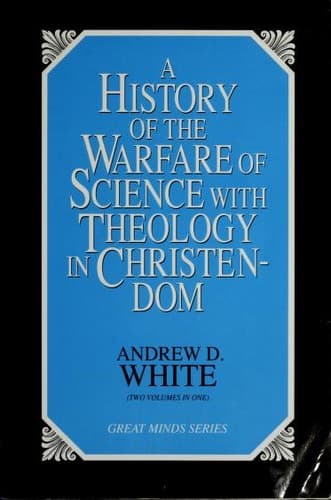
History of the Warfare of Science with Theology in ChristendomWhite, Andrew Dickson
Religion
History of the Warfare of Science with Theology in Christendom
White, Andrew Dickson
Religion and science -- History
This idea of these great fathers of the Eastern Church took even
stronger hold on the great father of the Western Church. For St.
Augustine, so fettered usually by the letter of the sacred text, broke
from his own famous doctrine as to the acceptance of Scripture and
spurned the generally received belief of a creative process like that by
which a toymaker brings into existence a box of playthings. In his great
treatise on Genesis he says: "To suppose that God formed man from the
dust with bodily hands is very childish.... God neither formed man with
bodily hands nor did he breathe upon him with throat and lips."
St. Augustine then suggests the adoption of the old emanation or
evolution theory, shows that "certain very small animals may not have
been created on the fifth and sixth days, but may have originated later
from putrefying matter," argues that, even if this be so, God is still
their creator, dwells upon such a potential creation as involved in the
actual creation, and speaks of animals "whose numbers the after-time
unfolded."
In his great treatise on the Trinity--the work to which he devoted the
best thirty years of his life--we find the full growth of this opinion.
He develops at length the view that in the creation of living beings
there was something like a growth--that God is the ultimate author,
but works through secondary causes; and finally argues that certain
substances are endowed by God with the power of producing certain
classes of plants and animals.(19)
(19) For the Chaldean view of creation, see George Smith, Chaldean
Account of Genesis, New York, 1876, pp. 14,15, and 64-86; also Lukas, as
above; also Sayce, Religion of the Ancient Babylonians, Hibbert Lectures
for 1887, pp. 371 and elsewhere; as to the fall of man, Tower of Babel,
sacredness of the number seven, etc., see also Delitzsch, appendix to
the German translation of Smith, pp. 305 et seq.; as to the almost exact
adoption of the Chaldean legends into the Hebrew sacred account, see
all these, as also Schrader, Die Keilinschriften und das Alte
Testament, Giessen, 1883, early chapters; also article Babylonia in
the Encyclopedia Britannica; as to similar approval of creation by the
Creator in both accounts, see George Smith, p. 73; as to the migration
of the Babylonian legends to the Hebrews, see Schrader, Whitehouse's
translation, pp. 44,45; as to the Chaldaean belief ina solid firmament,
while Schrader in 1883 thought it not proved, Jensen in 1890 has found
it clearly expresses--see his Kosmologie der Babylonier, pp.9 et seq.,
also pp. 304-306, and elsewhere. Dr. Lukas in 1893 also fully accepts
this view of a Chaldean record of a "firmament"--see Kosmologie, pp.
43, etc.; see also Maspero and Sayce, the Dawn of Civilization, and for
crude early ideas of evolution in Egypt, see ibid., pp. 156 et seq.
Public-domain text, read in full here on John Shaqi.
Reviews
Reviews
No reviews yet
Be the first to share your thoughts on this work.
Elsewhere in the archive
Join the Discussion
Join the discussion
Sign in to leave a comment or review.
Sign InorCreate an account