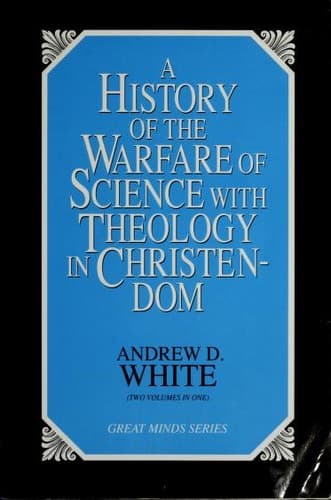
History of the Warfare of Science with Theology in ChristendomWhite, Andrew Dickson
Religion
History of the Warfare of Science with Theology in Christendom
White, Andrew Dickson
Religion and science -- History
The dialectic skill of the fathers was easily equal to explaining away
this contradiction; but the old current of thought, strengthened by both
these legends, arrested their attention, and, passing through the
minds of a succession of the greatest men of the Church, influenced
theological opinion deeply, if not widely, for ages, in favour of an
evolution theory.
But there was still another ancient source of evolution ideas.
Thoughtful men of the early civilizations which were developed along the
great rivers in the warmer regions of the earth noted how the sun-god as
he rose in his fullest might caused the water and the rich soil to teem
with the lesser forms of life. In Egypt, especially, men saw how
under this divine power the Nile slime brought forth "creeping things
innumerable." Hence mainly this ancient belief that the animals and
man were produced by lifeless matter at the divine command, "in the
beginning," was supplemented by the idea that some of the lesser
animals, especially the insects, were produced by a later evolution,
being evoked after the original creation from various sources, but
chiefly from matter in a state of decay.
This crude, early view aided doubtless in giving germs of a better
evolution theory to the early Greeks. Anaximander, Empedocles,
Anaxagoras, and, greatest of all, Aristotle, as we have seen, developed
them, making their way at times by guesses toward truths since
established by observation. Aristotle especially, both by speculation
and observation, arrived at some results which, had Greek freedom
of thought continued, might have brought the world long since to its
present plane of biological knowledge; for he reached something like the
modern idea of a succession of higher organizations from lower, and made
the fruitful suggestion of "a perfecting principle" in Nature.
With the coming in of Christian theology this tendency toward a yet
truer theory of evolution was mainly stopped, but the old crude view
remained, and as a typical example of it we may note the opinion of St.
Basil the Great in the fourth century. Discussing the work of creation,
he declares that, at the command of God, "the waters were gifted with
productive power"; "from slime and muddy places frogs, flies, and gnats
came into being"; and he finally declares that the same voice which gave
this energy and quality of productiveness to earth and water shall be
similarly efficacious until the end of the world. St. Gregory of Nyssa
held a similar view.
Public-domain text, read in full here on John Shaqi.
Reviews
Reviews
No reviews yet
Be the first to share your thoughts on this work.
Elsewhere in the archive
Join the Discussion
Join the discussion
Sign in to leave a comment or review.
Sign InorCreate an account