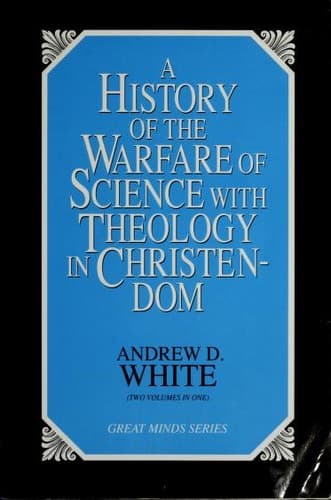
History of the Warfare of Science with Theology in ChristendomWhite, Andrew Dickson
Religion
History of the Warfare of Science with Theology in Christendom
White, Andrew Dickson
Religion and science -- History
Doubtless this theological necessity was among the main reasons which
led St. Isidore of Seville, in the seventh century, to incorporate
this theory, supported by St. Basil and St. Augustine, into his great
encyclopedic work which gave materials for thought on God and Nature to
so many generations. He familiarized the theological world still further
with the doctrine of secondary creation, giving such examples of it as
that "bees are generated from decomposed veal, beetles from horseflesh,
grasshoppers from mules, scorpions from crabs," and, in order to give
still stronger force to the idea of such transformations, he dwells
on the biblical account of Nebuchadnezzar, which appears to have taken
strong hold upon medieval thought in science, and he declares that
other human beings had been changed into animals, especially into swine,
wolves, and owls.
This doctrine of after-creations went on gathering strength until, in
the twelfth century, Peter Lombard, in his theological summary, The
Sentences, so powerful in moulding the thought of the Church, emphasized
the distinction between animals which spring from carrion and those
which are created from earth and water; the former he holds to have been
created "potentially" the latter "actually."
In the century following, this idea was taken up by St. Thomas Aquinas
and virtually received from him its final form. In the Summa, which
remains the greatest work of medieval thought, he accepts the idea that
certain animals spring from the decaying bodies of plants and animals,
and declares that they are produced by the creative word of God either
actually or virtually. He develops this view by saying, "Nothing was
made by God, after the six days of creation, absolutely new, but it was
in some sense included in the work of the six days"; and that "even
new species, if any appear, have existed before in certain native
properties, just as animals are produced from putrefaction."
The distinction thus developed between creation "causally" or
"potentially," and "materially" or "formally," was made much of by
commentators afterward. Cornelius a Lapide spread it by saying that
certain animals were created not "absolutely," but only "derivatively,"
and this thought was still further developed three centuries later by
Augustinus Eugubinus, who tells us that, after the first creative energy
had called forth land and water, light was made by the Almighty, the
instrument of all future creation, and that the light called everything
into existence.
Public-domain text, read in full here on John Shaqi.
Reviews
Reviews
No reviews yet
Be the first to share your thoughts on this work.
Elsewhere in the archive
Join the Discussion
Join the discussion
Sign in to leave a comment or review.
Sign InorCreate an account