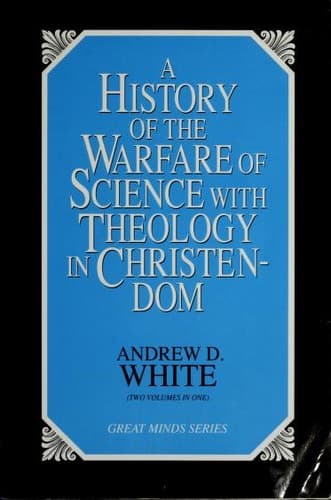
History of the Warfare of Science with Theology in ChristendomWhite, Andrew Dickson
Religion
History of the Warfare of Science with Theology in Christendom
White, Andrew Dickson
Religion and science -- History
All this "science falsely so called," so sedulously developed by the
master minds of the Church, and yet so futile that we might almost
suppose that the great apostle, in a glow of prophetic vision, had
foreseen it in his famous condemnation, seems at this distance very
harmless indeed; yet, to many guardians of the "sacred deposit of
doctrine" in the Church, even so slight a departure from the main
current of thought seemed dangerous. It appeared to them like pressing
the doctrine of secondary causes to a perilous extent; and about the
beginning of the seventeenth century we have the eminent Spanish Jesuit
and theologian Suarez denouncing it, and declaring St. Augustine a
heretic for his share in it.
But there was little danger to the older idea just then; the main
theological tendency was so strong that the world kept on as of old.
Biblical theology continued to spin its own webs out of its own bowels,
and all the lesser theological flies continued to be entangled in them;
yet here and there stronger thinkers broke loose from this entanglement
and helped somewhat to disentangle others.(20)
(20) For Bede's view of the ark and the origin of insects, see his
Hexaemeron, i and ii; for Isidore, see the Etymologiae, xi, 4, and xiii,
22; for Peter Lombard, see Sent., lib. ii, dist. xv, 4 (in Migne,
cxcii, 682); for St. Thomas Aquinas as to the laws of Nature, see Summae
Theologica, i, Quaest. lxvii, art. iv; for his discussion on Avicenna's
theory of the origin of animals, see ibid., i Quaest. lxxi, vol. i,
pp. 1184 and 1185, of Migne's edit.; for his idea as to the word of God
being the active producing principle, see ibid., i, Quaest. lxxi, art.
i; for his remarks on species, see ibid, i, Quaest. lxxii, art. i;
for his ideas on the necessity of the procreation of man, see ibid, i,
Quaest. lxxii, art. i; for the origin of animals from putrefaction,
see ibid, i, Quaest. lxxix, art. i, 3; for Cornelius a Lapide on the
derivative creation of animals, see his In Genesim Comment., cap. i,
cited by Mivart, Genesis of Species, p. 282; for a reference to Suarez's
denunciation of the view of St. Augustine, see Huxley's Essays.
At the close of the Middle Ages, in spite of the devotion of the
Reformed Church to the letter of Scripture, the revival of learning and
the great voyages gave an atmosphere in which better thinking on the
problems of Nature began to gain strength. On all sides, in every field,
men were making discoveries which caused the general theological view to
appear more and more inadequate.
Public-domain text, read in full here on John Shaqi.
Reviews
Reviews
No reviews yet
Be the first to share your thoughts on this work.
Elsewhere in the archive
Join the Discussion
Join the discussion
Sign in to leave a comment or review.
Sign InorCreate an account