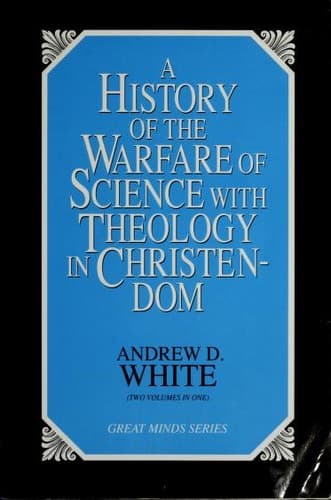
History of the Warfare of Science with Theology in ChristendomWhite, Andrew Dickson
Religion
History of the Warfare of Science with Theology in Christendom
White, Andrew Dickson
Religion and science -- History
In the second half of the eighteenth century a great barrier was thrown
across this current--the authority of Linnaeus. He was the most eminent
naturalist of his time, a wide observer, a close thinker; but the
atmosphere in which he lived and moved and had his being was saturated
with biblical theology, and this permeated all his thinking.
He who visits the tomb of Linnaeus to-day, entering the beautiful
cathedral of Upsala by its southern porch, sees above it, wrought in
stone, the Hebrew legend of creation. In a series of medallions, the
Almighty--in human form--accomplishes the work of each creative day. In
due order he puts in place the solid firmament with the waters above it,
the sun, moon, and stars within it, the beasts, birds, and plants below
it, and finishes his task by taking man out of a little hillock of "the
earth beneath," and woman out of man's side. Doubtless Linnaeus, as he
went to his devotions, often smiled at this childlike portrayal. Yet
he was never able to break away from the idea it embodied. At times, in
face of the difficulties which beset the orthodox theory, he ventured
to favour some slight concessions. Toward the end of his life he timidly
advanced the hypothesis that all the species of one genus constituted
at the creation one species; and from the last edition of his Systema
Naturae he quietly left out the strongly orthodox statement of the
fixity of each species, which he had insisted upon in his earlier works.
But he made no adequate declaration. What he might expect if he openly
and decidedly sanctioned a newer view he learned to his cost; warnings
came speedily both from the Catholic and Protestant sides.
At a time when eminent prelates of the older Church were eulogizing
debauched princes like Louis XV, and using the unspeakably obscene
casuistry of the Jesuit Sanchez in the education of the priesthood as to
the relations of men to women, the modesty of the Church authorities was
so shocked by Linnaeus's proofs of a sexual system in plants that for
many years his writings were prohibited in the Papal States and in
various other parts of Europe where clerical authority was strong enough
to resist the new scientific current. Not until 1773 did one of the
more broad-minded cardinals--Zelanda--succeed in gaining permission that
Prof. Minasi should discuss the Linnaean system at Rome.
Public-domain text, read in full here on John Shaqi.
Reviews
Reviews
No reviews yet
Be the first to share your thoughts on this work.
Elsewhere in the archive
Join the Discussion
Join the discussion
Sign in to leave a comment or review.
Sign InorCreate an account