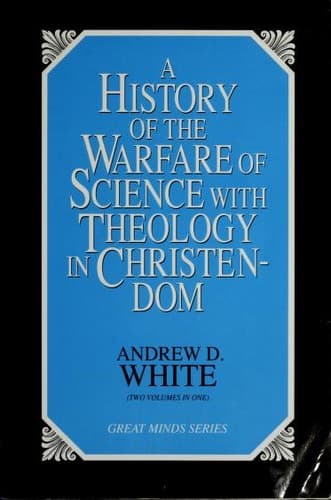
History of the Warfare of Science with Theology in ChristendomWhite, Andrew Dickson
Religion
History of the Warfare of Science with Theology in Christendom
White, Andrew Dickson
Religion and science -- History
Spinoza, Hume, and Kant may also be mentioned as among those whose
thinking, even when mistaken, might have done much to aid in the
development of a truer theory had not the theologic atmosphere of their
times been so unpropitious; but a few years after Leibnitz's death came
in France a thinker in natural science of much less influence than any
of these, who made a decided step forward.
Early in the eighteenth century Benoist de Maillet, a man of the world,
but a wide observer and close thinker upon Nature, began meditating
especially upon the origin of animal forms, and was led into the idea of
the transformation of species and so into a theory of evolution, which
in some important respects anticipated modern ideas. He definitely,
though at times absurdly, conceived the production of existing species
by the modification of their predecessors, and he plainly accepted one
of the fundamental maxims of modern geology--that the structure of the
globe must be studied in the light of the present course of Nature.
But he fell between two ranks of adversaries. On one side, the Church
authorities denounced him as a freethinker; on the other, Voltaire
ridiculed him as a devotee. Feeling that his greatest danger was from
the orthodox theologians, De Maillet endeavoured to protect himself
by disguising his name in the title of his book, and by so wording its
preface and dedication that, if persecuted, he could declare it a mere
sport of fancy; he therefore announced it as the reverie of a Hindu sage
imparted to a Christian missionary. But this strategy availed nothing:
he had allowed his Hindu sage to suggest that the days of creation named
in Genesis might be long periods of time; and this, with other ideas of
equally fearful import, was fatal. Though the book was in type in 1735,
it was not published till 1748--three years after his death.
On the other hand, the heterodox theology of Voltaire was also aroused;
and, as De Maillet had seen in the presence of fossils on high mountains
a proof that these mountains were once below the sea, Voltaire,
recognising in this an argument for the deluge of Noah, ridiculed the
new thinker without mercy. Unfortunately, some of De Maillet's vagaries
lent themselves admirably to Voltaire's sarcasm; better material for it
could hardly be conceived than the theory, seriously proposed, that the
first human being was born of a mermaid.
Hence it was that, between these two extremes of theology, De Maillet
received no recognition until, very recently, the greatest men of
science in England and France have united in giving him his due. But
his work was not lost, even in his own day; Robinet and Bonnet pushed
forward victoriously on helpful lines.
Public-domain text, read in full here on John Shaqi.
Reviews
Reviews
No reviews yet
Be the first to share your thoughts on this work.
Elsewhere in the archive
Join the Discussion
Join the discussion
Sign in to leave a comment or review.
Sign InorCreate an account