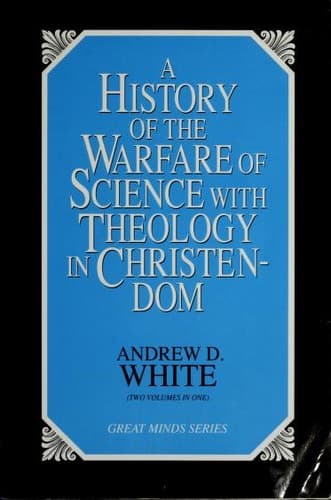
History of the Warfare of Science with Theology in ChristendomWhite, Andrew Dickson
Religion
History of the Warfare of Science with Theology in Christendom
White, Andrew Dickson
Religion and science -- History
But no one outside of a circle apparently uninfluential cared for
these things: the Church was serene: on the Continent it had obtained
reactionary control of courts, cabinets, and universities; in England,
Dean Cockburn was denouncing Mary Somerville and the geologists to the
delight of churchmen; and the Rev. Mellor Brown was doing the same thing
for the edification of dissenters.
In America the mild suggestions of Silliman and his compeers were met
by the protestations of the Andover theologians headed by Moses Stuart.
Neither of the great English universities, as a rule, took any notice of
the innovators save by sneers.
To this current of thought there was joined a new element when, in
1844, Robert Chambers published his Vestiges of Creation. The book was
attractive and was widely read. In Chambers's view the several series of
animated beings, from the simplest and oldest up to the highest and most
recent, were the result of two distinct impulses, each given once and
for all time by the Creator. The first of these was an impulse imparted
to forms of life, lifting them gradually through higher grades; the
second was an impulse tending to modify organic substances in accordance
with external circumstances; in fact, the doctrine of the book was
evolution tempered by miracle--a stretching out of the creative act
through all time--a pious version of Lamarck.
Two results followed, one mirth-provoking, the other leading to serious
thought. The amusing result was that the theologians were greatly
alarmed by the book: it was loudly insisted that it promoted atheism.
Looking back along the line of thought which has since been developed,
one feels that the older theologians ought to have put up thanksgivings
for Chambers's theory, and prayers that it might prove true. The
more serious result was that it accustomed men's minds to a belief in
evolution as in some form possible or even probable. In this way it was
provisionally of service.
Eight years later Herbert Spencer published an essay contrasting the
theories of creation and evolution--reasoning with great force in favour
of the latter, showing that species had undoubtedly been modified by
circumstances; but still only few and chosen men saw the significance
of all these lines of reasoning which had been converging during so many
years toward one conclusion.
On July 1, 1858, there were read before the Linnaean Society at London
two papers--one presented by Charles Darwin, the other by Alfred Russel
Wallace--and with the reading of these papers the doctrine of evolution
by natural selection was born. Then and there a fatal breach was made in
the great theological barrier of the continued fixity of species since
the creation.
Public-domain text, read in full here on John Shaqi.
Reviews
Reviews
No reviews yet
Be the first to share your thoughts on this work.
Elsewhere in the archive
Join the Discussion
Join the discussion
Sign in to leave a comment or review.
Sign InorCreate an account