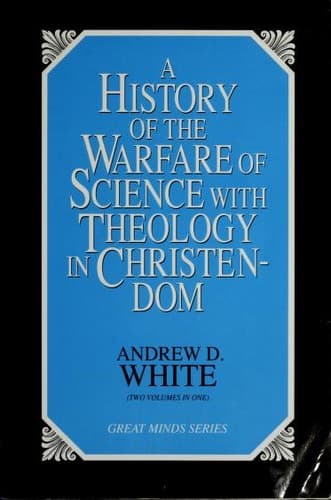
History of the Warfare of Science with Theology in ChristendomWhite, Andrew Dickson
Religion
History of the Warfare of Science with Theology in Christendom
White, Andrew Dickson
Religion and science -- History
The story of these papers the scientific world knows by heart: how
Charles Darwin, having been sent to the University of Cambridge to
fit him for the Anglican priesthood, left it in 1831 to go upon the
scientific expedition of the Beagle; how for five years he studied with
wonderful vigour and acuteness the problems of life as revealed on
land and at sea--among volcanoes and coral reefs, in forests and on the
sands, from the tropics to the arctic regions; how, in the Cape Verde
and the Galapagos Islands, and in Brazil, Patagonia, and Australia
he interrogated Nature with matchless persistency and skill; how he
returned unheralded, quietly settled down to his work, and soon set the
world thinking over its first published results, such as his book on
Coral Reefs, and the monograph on the Cirripedia; and, finally, how he
presented his paper, and followed it up with treatises which made him
one of the great leaders in the history of human thought.
The scientific world realizes, too, more and more, the power of
character shown by Darwin in all this great career; the faculty of
silence, the reserve of strength seen in keeping his great thought--his
idea of evolution by natural selection--under silent study and
meditation for nearly twenty years, giving no hint of it to the world
at large, but working in every field to secure proofs or disproofs,
and accumulating masses of precious material for the solution of the
questions involved.
To one man only did he reveal his thought--to Dr. Joseph Hooker, to
whom in 1844, under the seal of secrecy, he gave a summary of his
conclusions. Not until fourteen years later occurred the event which
showed him that the fulness of time had come--the letter from Alfred
Russel Wallace, to whom, in brilliant researches during the decade from
1848 to 1858, in Brazil and in the Malay Archipelago, the same truth of
evolution by natural selection had been revealed. Among the proofs that
scientific study does no injury to the more delicate shades of sentiment
is the well-known story of this letter. With it Wallace sent Darwin a
memoir, asking him to present it to the Linnaean Society: on examining
it, Darwin found that Wallace had independently arrived at conclusions
similar to his own--possibly had deprived him of fame; but Darwin was
loyal to his friend, and his friend remained ever loyal to him. He
publicly presented the paper from Wallace, with his own conclusions; and
the date of this presentation--July 1, 1858--separates two epochs in the
history, not merely of natural science, but of human thought.
Public-domain text, read in full here on John Shaqi.
Reviews
Reviews
No reviews yet
Be the first to share your thoughts on this work.
Elsewhere in the archive
Join the Discussion
Join the discussion
Sign in to leave a comment or review.
Sign InorCreate an account