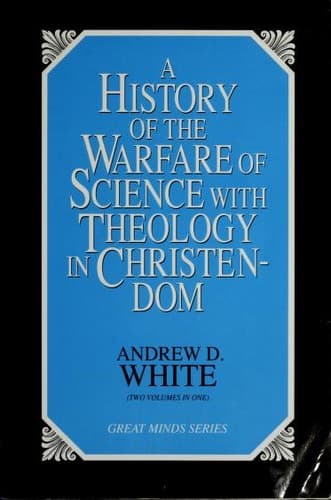
History of the Warfare of Science with Theology in ChristendomWhite, Andrew Dickson
Religion
History of the Warfare of Science with Theology in Christendom
White, Andrew Dickson
Religion and science -- History
A great investigator, an inspired and inspiring teacher, a noble man, he
had received and elaborated a theory of animated creation which he could
not readily change. In his heart and mind still prevailed the atmosphere
of the little Swiss parsonage in which he was born, and his religious
and moral nature, so beautiful to all who knew him, was especially
repelled by sundry evolutionists, who, in their zeal as neophytes, made
proclamations seeming to have a decidedly irreligious if not immoral
bearing. In addition to this was the direction his thinking had received
from Cuvier. Both these influences combined to prevent his acceptance of
the new view.
He was the third great man who had thrown his influence as a barrier
across the current of evolutionary thought. Linnaeus in the second half
of the eighteenth century, Cuvier in the first half, and Agassiz in the
second half of the nineteenth--all made the same effort. Each remains
great; but not all of them together could arrest the current. Agassiz's
strong efforts throughout the United States, and indeed throughout
Europe, to check it, really promoted it. From the great museum he had
founded at Cambridge, from his summer school at Penikese, from his
lecture rooms at Harvard and Cornell, his disciples went forth full of
love and admiration for him, full of enthusiasm which he had stirred
and into fields which he had indicated; but their powers, which he had
aroused and strengthened, were devoted to developing the truth he failed
to recognise; Shaler, Verrill, Packard, Hartt, Wilder, Jordan, with a
multitude of others, and especially the son who bore his honoured name,
did justice to his memory by applying what they had received from him to
research under inspiration of the new revelation.
Still another man deserves especial gratitude and honour in this
progress--Edward Livingston Youmans. He was perhaps the first in America
to recognise the vast bearings of the truths presented by Darwin,
Wallace, and Spencer. He became the apostle of these truths, sacrificing
the brilliant career on which he had entered as a public lecturer,
subordinating himself to the three leaders, and giving himself to
editorial drudgery in the stimulation of research and the announcement
of results.
In support of the new doctrine came a world of new proofs; those which
Darwin himself added in regard to the cross-fertilization of plants,
and which he had adopted from embryology, led the way, and these were
followed by the discoveries of Wallace, Bates, Huxley, Marsh, Cope,
Leidy, Haeckel, Muller, Gaudry, and a multitude of others in all
lands.(22)
Public-domain text, read in full here on John Shaqi.
Reviews
Reviews
No reviews yet
Be the first to share your thoughts on this work.
Elsewhere in the archive
Join the Discussion
Join the discussion
Sign in to leave a comment or review.
Sign InorCreate an account