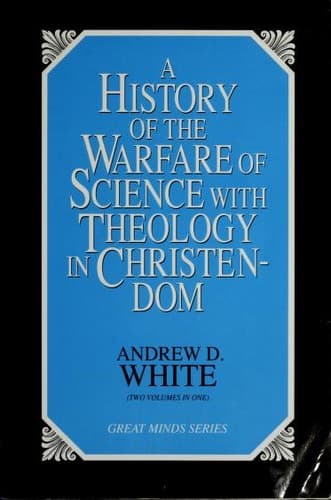
History of the Warfare of Science with Theology in ChristendomWhite, Andrew Dickson
Religion
History of the Warfare of Science with Theology in Christendom
White, Andrew Dickson
Religion and science -- History
(22) For Agassiz's opposition to evolution, see the Essay on
Classification, vol. i, 1857, as regards Lamark, and vol. iii, as
regards Darwin; also Silliman's Journal, July 1860; also the Atlantic
Monthly, January 1874; also his Life and Correspondence, vol. ii, p.
647; also Asa Gray, Scientific Papers, vol. ii, p. 484. A reminiscence
of my own enables me to appreciate his deep ethical and religious
feeling. I was passing the day with him at Nahant in 1868, consulting
him regarding candidates for various scientific chairs at the newly
established Cornell University, in which he took a deep interest. As we
discussed one after another of the candidates, he suddenly said: "Who is
to be your Professor of Moral Philosophy? That is a far more important
position than all the others."
IV. THE FINAL EFFORT OF THEOLOGY.
Darwin's Origin of Species had come into the theological world like
a plough into an ant-hill. Everywhere those thus rudely awakened from
their old comfort and repose had swarmed forth angry and confused.
Reviews, sermons, books light and heavy, came flying at the new thinker
from all sides.
The keynote was struck at once in the Quarterly Review by Wilberforce,
Bishop of Oxford. He declared that Darwin was guilty of "a tendency to
limit God's glory in creation"; that "the principle of natural selection
is absolutely incompatible with the word of God"; that it "contradicts
the revealed relations of creation to its Creator"; that it is
"inconsistent with the fulness of his glory"; that it is "a dishonouring
view of Nature"; and that there is "a simpler explanation of the
presence of these strange forms among the works of God": that
explanation being--"the fall of Adam." Nor did the bishop's efforts end
here; at the meeting of the British Association for the Advancement
of Science he again disported himself in the tide of popular applause.
Referring to the ideas of Darwin, who was absent on account of illness,
he congratulated himself in a public speech that he was not descended
from a monkey. The reply came from Huxley, who said in substance: "If
I had to choose, I would prefer to be a descendant of a humble monkey
rather than of a man who employs his knowledge and eloquence in
misrepresenting those who are wearing out their lives in the search for
truth."
This shot reverberated through England, and indeed through other
countries.
The utterances of this the most brilliant prelate of the Anglican Church
received a sort of antiphonal response from the leaders of the English
Catholics. In an address before the "Academia," which had been organized
to combat "science falsely so called," Cardinal Manning declared his
abhorrence of the new view of Nature, and described it as "a brutal
philosophy--to wit, there is no God, and the ape is our Adam."
Public-domain text, read in full here on John Shaqi.
Reviews
Reviews
No reviews yet
Be the first to share your thoughts on this work.
Elsewhere in the archive
Join the Discussion
Join the discussion
Sign in to leave a comment or review.
Sign InorCreate an account