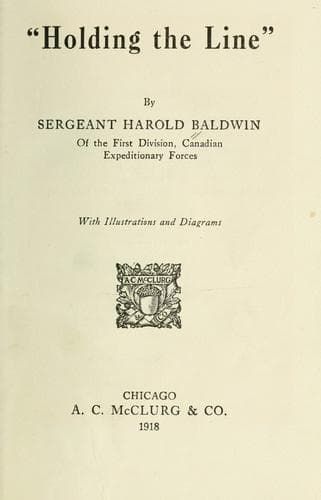
World War, 1914-1918 -- Campaigns -- Western Front; World War, 1914-1918 -- Personal narratives, Canadian
Our experiences in making change for our purchases uniquely expressed
the old saying, "money talks," because the dealers everywhere seemed
to be thoroughly acquainted with the values of English currency,
although they couldn't speak the language.
Here we stayed for a few days until our march to the trenches began.
Nightly, as we lay, we could hear the boom of an occasional big gun,
the rattle of rapid rifle fire, and now and again the peculiar
metallic click and whir of machine guns.
It was in this place that the clock-tower incident occurred: Someone
noticed the hands of the clock on the east end of the tower moving
strangely; two men were sent up to investigate. They did not return
and a search was made for them. They could not be located, but
suspicious sounds were heard up in the tower. The officers decided
it was a case for the guns. One shell brought the tower tumbling
down and with it came the bodies of two German spies and the men who
had been sent to investigate. The spies had been using the hands of
the clock for signaling purposes.
CHAPTER XII
MY BAPTISM OF FIRE
On the morning before we set out for the trenches we were inspected
by Sir John French and other well-known leaders of the British Army.
That night the guns roared, Maxims barked and rifles kept up an
incessant fire all night. We began to have a very heartfelt idea of
what we were in for and the tightening up of the faces of the men was
distinctly perceptible, accompanied with ejaculations from some of
the English Tommies in our battalion, such as "Gawd blime me, but
it's gettin' close now."
Next day at about twelve o'clock we fell in, joined the remainder of
the battalion in Hazebrouck, and the march to Armentieres commenced.
This march will long be remembered by all who survived. Everyone was
in great spirits, and songs and jokes were the order. Along the
cobbled roads we swung in full marching order, and the first part of
the journey was accomplished with ease. But those awful cobbled
roads began to tell their tale. They are paved with rough, uneven
cobbles, and when a little rain has fallen a man goes slipping and
sliding all over the place. A thin layer of mud makes it ten times
worse; so by the time we had done fifteen miles, men began to lag.
On and on we went, until at last the officers were obliged to halt
the men.
As is usual, toward evening we felt better, and lustily informed the
natives that, "The Gang's All Here;" "Here We Are Again;" and various
choruses of a like nature were roared by us as we swung like one man
into Armentieres. Here we received vociferous welcome from those
fearless fighting men, the boys of the British regular army. Their
welcome was a royal as well as a noisy one, because they shoved
refreshing drinks and cigarettes into our hands, which were eagerly
taken.
"What in blazes do you call this stuff?" I asked of a burly Tommy who
had thrust a bottle of liquid at me.
Public-domain text, read in full here on John Shaqi.
Reviews
Reviews
No reviews yet
Be the first to share your thoughts on this work.
Join the Discussion
Join the discussion
Sign in to leave a comment or review.
Sign InorCreate an account