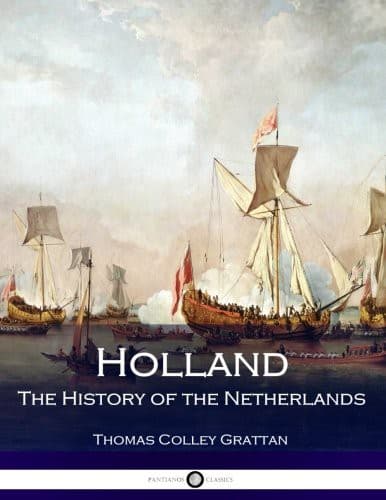
Holland: The History of the NetherlandsGrattan, Thomas Colley
History
Holland: The History of the Netherlands
Grattan, Thomas Colley
Netherlands -- History
The king's first care on, receiving this advice was to order, in
all the principal towns of Spain and the Netherlands, prayer and
processions to implore the divine approbation on the resolutions
which he had formed. He appeared then in person at the council of
state, and issued a decree, by which he refused his consent to
the convocation of the states-general, and bound himself to take
several German regiments into his pay. He ordered the duchess
of Parma, by a private letter, to immediately cause to be raised
three thousand cavalry and ten thousand foot, and he remitted to
her for this purpose three hundred thousand florins in gold. He
next wrote with his own hand to several of his partisans in the
various towns, encouraging them in their fidelity to his purpose,
and promising them his support. He rejected the adoption of the
moderation recommended to him; but he consented to the abolition
of the inquisition in its most odious sense, re-establishing
that modified species of ecclesiastical tyranny which had been
introduced into the Netherlands by Charles V. The people of that
devoted country were thus successful in obtaining one important
concession from the king, and in meeting unexpected consideration
from this Spanish council. Whether these measures had been calculated
with a view to their failure, it is not now easy to determine;
at all events they came too late. When Philip's letters reached
Brussels, the iconoclasts or image-breakers were abroad.
It requires no profound research to comprehend the impulse which
leads a horde of fanatics to the most monstrous excesses. That
the deeds of the iconoclasts arose from the spontaneous outburst
of mere vulgar fury, admits of no doubt. The aspersion which
would trace those deeds to the meeting of St. Trond, and fix
the infamy on the body of nobility there assembled, is scarcely
worthy of refutation. The very lowest of the people were the
actors as well as the authors of the outrages, which were at
once shocking to every friend of liberty, and injurious to that
sacred cause. Artois and western Flanders were the scenes of the
first exploits of the iconoclasts. A band of peasants, intermixed
with beggars and various other vagabonds, to the amount of about
three hundred, urged by fanaticism and those baser passions which
animate every lawless body of men, armed with hatchets, clubs, and
hammers, forced open the doors of some of the village churches
in the neighborhood of St. Omer, and tore down and destroyed not
only the images and relics of saints, but those very ornaments
which Christians of all sects hold sacred, and essential to the
most simple rites of religion.
Public-domain text, read in full here on John Shaqi.
Reviews
Reviews
No reviews yet
Be the first to share your thoughts on this work.
Elsewhere in the archive
Join the Discussion
Join the discussion
Sign in to leave a comment or review.
Sign InorCreate an account