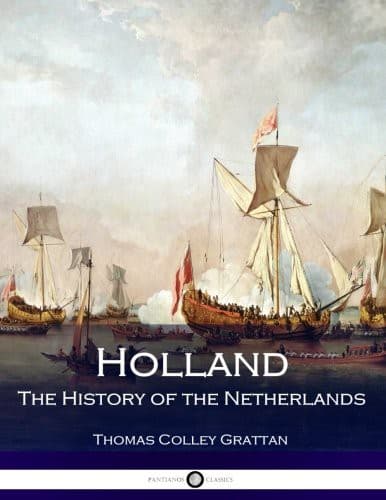
Holland: The History of the NetherlandsGrattan, Thomas Colley
History
Holland: The History of the Netherlands
Grattan, Thomas Colley
Netherlands -- History
The cities of Ypres, Lille, and other places of importance, were
soon subject to similar visitations; and the whole of Flanders
was in a few days ravaged by furious multitudes, whose frantic
energy spread terror and destruction on their route. Antwerp was
protected for a while by the presence of the Prince of Orange;
but an order from the stadtholderess having obliged him to repair
to Brussels, a few nights after his departure the celebrated
cathedral shared the fate of many a minor temple, and was utterly
pillaged. The blind fury of the spoilers was not confined to
the mere effigies which they considered the types of idolatry,
nor even to the pictures, the vases, the sixty-six altars, and
their richly wrought accessories; but it was equally fatal to the
splendid organ, which was considered the finest at that time in
existence. The rapidity and the order with which this torch-light
scene was acted, without a single accident among the numerous
doers, has excited the wonder of almost all its early historians.
One of them does not hesitate to ascribe the "miracle" to the
absolute agency of demons. For three days and nights these revolting
scenes were acted, and every church in the city shared the fate
of the cathedral, which next to St. Peter's at Rome was the most
magnificent in Christendom.
Ghent, Tournay, Valenciennes, Mechlin, and other cities, were next
the theatres of similar excesses; and in an incredibly short space
of time above four hundred churches were pillaged in Flanders and
Brabant. Zealand, Utrecht, and others of the northern provinces,
suffered more or less; Friesland, Guelders, and Holland alone
escaped, and even the latter but in partial instances.
These terrible scenes extinguished every hope of reconciliation
with the king. An inveterate and interminable hatred was now
established between him and the people; for the whole nation
was identified with deeds which were in reality only shared by
the most base, and were loathsome to all who were enlightened.
It was in vain that the patriot nobles might hope or strive to
exclupate themselves; they were sure to be held criminal either
in fact or by implication. No show of loyalty, no efforts to
restore order, no personal sacrifice, could save them from the
hatred or screen them from the vengeance of Philip.
Public-domain text, read in full here on John Shaqi.
Reviews
Reviews
No reviews yet
Be the first to share your thoughts on this work.
Elsewhere in the archive
Join the Discussion
Join the discussion
Sign in to leave a comment or review.
Sign InorCreate an account