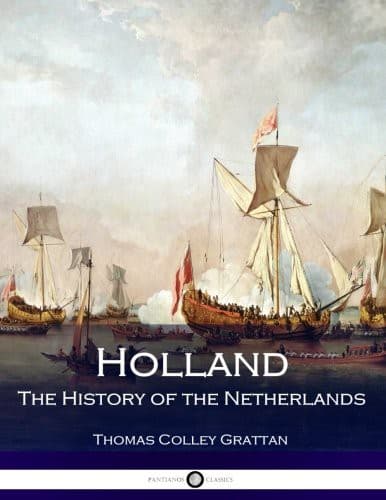
Holland: The History of the NetherlandsGrattan, Thomas Colley
History
Holland: The History of the Netherlands
Grattan, Thomas Colley
Netherlands -- History
This siege formed another of those numerous instances which became
so memorable from the mixture of heroism and horror. Jean Vanderdoes,
known in literature by the name of Dousa, and celebrated for his
Latin poems, commanded the place. Valdez, who conducted the siege,
urged Dousa to surrender; when the latter replied, in the name of
the inhabitants, "that when provisions failed them, they would
devour their left hands, reserving the right to defend their
liberty." A party of the inhabitants, driven to disobedience and
revolt by the excess of misery to which they were shortly reduced,
attempted to force the burgomaster, Vanderwerf, to supply them with
bread, or yield up the place. But he sternly made the celebrated
answer, which, cannot be remembered without shuddering--"Bread I
have none; but if my death can afford you relief, tear my body
in pieces, and let those who are most hungry devour it!"
But in this extremity relief at last was afforded by the decisive
measures of the Prince of Orange, who ordered all the neighboring
dikes to be opened and the sluices raised, thus sweeping away the
besiegers on the waves of the ocean: the inhabitants of Leyden
were apprised of this intention by means of letters intrusted
to the safe carriage of pigeons trained for the purpose. The
inundation was no sooner effected than hundreds of flat-bottomed
boats brought abundance of supplies to the half-famished town;
while a violent storm carried the sea across the country for
twenty leagues around, and destroyed the Spanish camp, with above
one thousand soldiers, who were overtaken by the flood. This
deliverance took place on the 3d of October, on which day it
is still annually celebrated by the descendants of the grateful
citizens.
It was now for the first time that Spain would consent to listen
to advice or mediation, which had for its object the termination
of this frightful war. The emperor Maximilian II. renewed at
this epoch his efforts with Philip; and under such favorable
auspices conferences commenced at Breda, where the counts
Swartzenberg and Hohenloe, brothers-in-law of the Prince of Orange,
met, on the part of the emperor, the deputies from the king of
Spain and the patriots; and hopes of a complete pacification
were generally entertained. But three months of deliberation
proved their fallacy. The patriots demanded toleration for the
reformed religion. The king's deputies obstinately refused it.
The congress was therefore broken up; and both oppressors and
oppressed resumed their arms with increased vigor and tenfold
desperation.
Requesens had long fixed his eyes on Zealand as the scene of an
expedition by which he hoped to repair the failure before Leyden;
and he caused an attempt to be made on the town of Zuriczee, in
the island of Scauwen, which merits record as one of the boldest
and most original enterprises of the war.
Public-domain text, read in full here on John Shaqi.
Reviews
Reviews
No reviews yet
Be the first to share your thoughts on this work.
Elsewhere in the archive
Join the Discussion
Join the discussion
Sign in to leave a comment or review.
Sign InorCreate an account