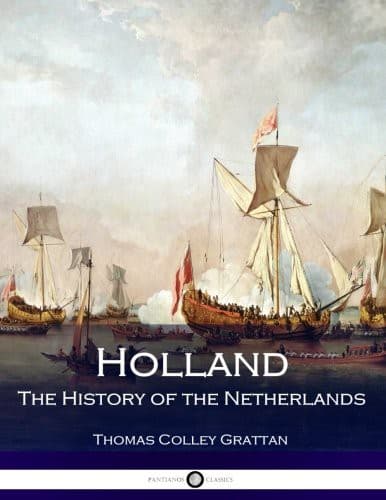
Holland: The History of the NetherlandsGrattan, Thomas Colley
History
Holland: The History of the Netherlands
Grattan, Thomas Colley
Netherlands -- History
The little islands of Zealand are separated from each other by
narrow branches of the sea, which are fordable at low water;
and it was by such a passage, two leagues in breadth, and till
then untried, that the Spanish detachment of one thousand seven
hundred and fifty men, under Ulloa and other veteran captains,
advanced to their exploit in the midst of dangers greatly increased
by a night of total darkness. Each man carried round his neck
two pounds of gunpowder, with a sufficient supply of biscuit
for two days; and holding their swords and muskets high over
their heads, they boldly waded forward, three abreast, in some
places up to their shoulders in water. The alarm was soon given;
and a shower of balls was poured upon the gallant band, from
upward of forty boats which the Zealanders sent rapidly toward
the spot. The only light afforded to either party was from the
flashes of their guns; and while the adventurers advanced with
undaunted firmness, their equally daring assailants, jumping
from their boats into the water, attacked them with oars and
hooked handspikes, by which many of the Spaniards were destroyed.
The rearguard, in this extremity, cut off from their companions,
was obliged to retreat; but the rest, after a considerable loss,
at length reached the land, and thus gained possession of the
island, on the night of the 28th of September, 1575.
Requesens quickly afterward repaired to the scene of this gallant
exploit, and commenced the siege of Zuriczee, which he did not
live to see completed. After having passed the winter months
in preparation for the success of this object which he had so
much at heart, he was recalled to Brussels by accounts of new
mutinies in the Spanish cavalry; and the very evening before
he reached the city he was attacked by a violent fever, which
carried him off five days afterward, on the 5th of March, 1516.
The suddenness of Requesen's illness had not allowed time for
even the nomination of a successor, to which he was authorized by
letters patent from the king. It is believed that his intention
was to appoint Count Mansfield to the command of the army, and De
Berlaimont to the administration of civil affairs. The government,
however, now devolved entirely into the hands of the council of
state, which was at that period composed of nine members. The
principal of these was Philip de Croi, duke of Arschot; the other
leading members were Viglius, Counts Mansfield and Berlaimont; and
the council was degraded by numbering, among the rest, Debris
and De Roda, two of the notorious Spaniards who had formed part
of the Council of Blood.
Public-domain text, read in full here on John Shaqi.
Reviews
Reviews
No reviews yet
Be the first to share your thoughts on this work.
Elsewhere in the archive
Join the Discussion
Join the discussion
Sign in to leave a comment or review.
Sign InorCreate an account