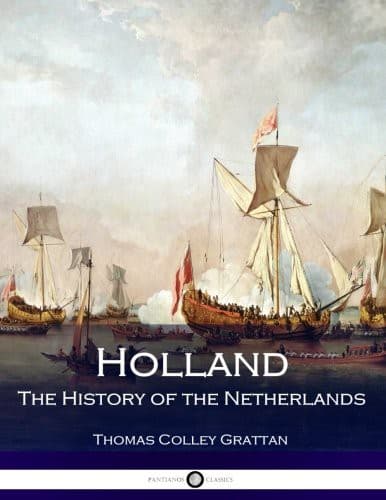
Holland: The History of the NetherlandsGrattan, Thomas Colley
History
Holland: The History of the Netherlands
Grattan, Thomas Colley
Netherlands -- History
The history of the Netherlands is, then, essentially that of
a patient and industrious population struggling against every
obstacle which nature could oppose to its well-being; and, in
this contest, man triumphed most completely over the elements
in those places where they offered the greatest resistance. This
extraordinary result was due to the hardy stamp of character
imprinted by suffering and danger on those who had the ocean for
their foe; to the nature of their country, which presented no
lure for conquest; and, finally, to the toleration, the justice,
and the liberty nourished among men left to themselves, and who
found resources in their social state which rendered change neither
an object of their wants nor wishes.
About half a century before the Christian era, the obscurity
which enveloped the north of Europe began to disperse; and the
expedition of Julius Cæsar gave to the civilized world the first
notions of the Netherlands, Germany, and England. Cæsar, after
having subjugated the chief part of Gaul, turned his arms against
the warlike tribes of the Ardennes, who refused to accept his
alliance or implore his protection. They were called Belgæ by
the Romans; and at once pronounced the least civilized and the
bravest of the Gauls. Cæsar there found several ignorant and poor
but intrepid clans of warriors, who marched fiercely to encounter
him; and, notwithstanding their inferiority in numbers, in weapons,
and in tactics, they nearly destroyed the disciplined armies of
Rome. They were, however, defeated, and their country ravaged
by the invaders, who found less success when they attacked the
natives of the low grounds. The Menapians, a people who occupied
the present provinces of Flanders and Antwerp, though less numerous
than those whom the Romans had last vanquished, arrested their
progress both by open fight and by that petty and harassing
contest--that warfare of the people rather than of the soldiery--so
well adapted to the nature of the country. The Roman legions
retreated for the first time, and were contented to occupy the
higher parts, which now form the Walloon provinces.
Public-domain text, read in full here on John Shaqi.
Reviews
Reviews
No reviews yet
Be the first to share your thoughts on this work.
Join the Discussion
Join the discussion
Sign in to leave a comment or review.
Sign InorCreate an account