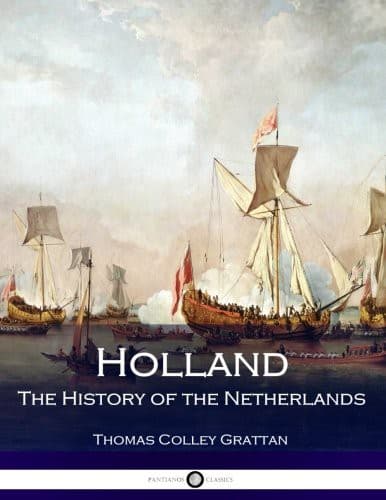
Holland: The History of the NetherlandsGrattan, Thomas Colley
History
Holland: The History of the Netherlands
Grattan, Thomas Colley
Netherlands -- History
And is it to be
believed that he who for twenty years had sacrificed his repose,
lavished his fortune, and risked his life, for the public cause,
now aimed at absolute dominion, or coveted a despotism which
all his actions prove him to have abhorred? Defeated bigotry
has put forward such vapid accusations. He has been also held
responsible for the early cruelties which, it is notorious, he
used every means to avert, and frequently punished. But while
these revolting acts can only be viewed in the light of reprisals
against the bloodiest persecution that ever existed, by exasperated
men driven to vengeance by a bad example, not one single act of
cruelty or bad faith has ever been made good against William,
who may be safely pronounced one of the wisest and best men that
history has held up as examples to the species.
The authority of one author has been produced to prove that,
during the lifetime of his brother Louis, offers were made to
him by France of the sovereignty of the northern provinces, on
condition of the southern being joined to the French crown. That
he ever accepted those offers is without proof; that he never
acted on them is certain. But he might have been justified in
purchasing freedom for those states which had so well earned
it, at the price even of a qualified independence under another
power, to the exclusion of those which had never heartily struggled
against Spain. The best evidence, however, of William's real views
is to be found in the Capitulation, as it is called; that is to
say, the act which was on the point of being executed between him
and the states, when a base fanatic, instigated by a bloody tyrant,
put a period to his splendid career. This capitulation exists at
full length, but was never formally executed. Its conditions
are founded on the same principles, and conceived in nearly the
same terms, as those accepted by the duke of Anjou; and the whole
compact is one of the most thoroughly liberal that history has
on record. The prince repaired to Delft for the ceremony of his
inauguration, the price of his long labors; but there, instead
of anticipated dignity, he met the sudden stroke of death.
Public-domain text, read in full here on John Shaqi.
Reviews
Reviews
No reviews yet
Be the first to share your thoughts on this work.
Elsewhere in the archive
Join the Discussion
Join the discussion
Sign in to leave a comment or review.
Sign InorCreate an account