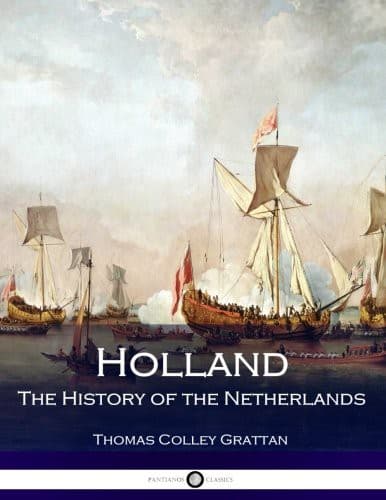
Holland: The History of the NetherlandsGrattan, Thomas Colley
History
Holland: The History of the Netherlands
Grattan, Thomas Colley
Netherlands -- History
The death of William of Nassau not only closes the scene of his
individual career, but throws a deep gloom over the history of a
revolution that was sealed by so great a sacrifice. The animation
of the story seems suspended. Its events lose for a time their
excitement. The last act of the political drama is performed. The
great hero of the tragedy is no more. The other most memorable
actors have one by one passed away. A whole generation has fallen
in the contest; and it is with exhausted interest, and feelings
less intense, that we resume the details of war and blood, which
seem no longer sanctified by the grander movements of heroism.
The stirring impulse of slavery breaking its chains yields to
the colder inspiration of independence maintaining its rights.
The men we have now to depict were born free; and the deeds they
did were those of stern resolve rather than of frantic despair.
The present picture may be as instructive as the last, but it is
less thrilling. Passion gives place to reason; and that which
wore the air of fierce romance is superseded by what bears the
stamp of calm reality.
The consternation caused by the news of William's death soon
yielded to the firmness natural to a people inured to suffering
and calamity. The United Provinces rejected at once the overtures
made by the prince of Parma to induce them to obedience. They
seemed proud to show that their fate did not depend on that of
one man. He therefore turned his attention to the most effective
means of obtaining results by force which he found it impossible
to secure by persuasion. He proceeded vigorously to the reduction
of the chief towns of Flanders, the conquest of which would give
him possession of the entire province, no army now remaining
to oppose him in the field. He soon obliged Ypres and Termonde
to surrender; and Ghent, forced by famine, at length yielded on
reasonable terms. The most severe was the utter abolition of
the reformed religion; by which a large portion of the population
was driven to the alternative of exile; and they passed over
in crowds to Holland and Zealand, not half of the inhabitants
remaining behind. Mechlin, and finally Brussels, worn out by
a fruitless resistance, followed the example of the rest; and
thus, within a year after the death of William of Nassau, the
power of Spain was again established in the whole province of
Flanders, and the others which comprise what is in modern days
generally denominated Belgium.
Public-domain text, read in full here on John Shaqi.
Reviews
Reviews
No reviews yet
Be the first to share your thoughts on this work.
Elsewhere in the archive
Join the Discussion
Join the discussion
Sign in to leave a comment or review.
Sign InorCreate an account